
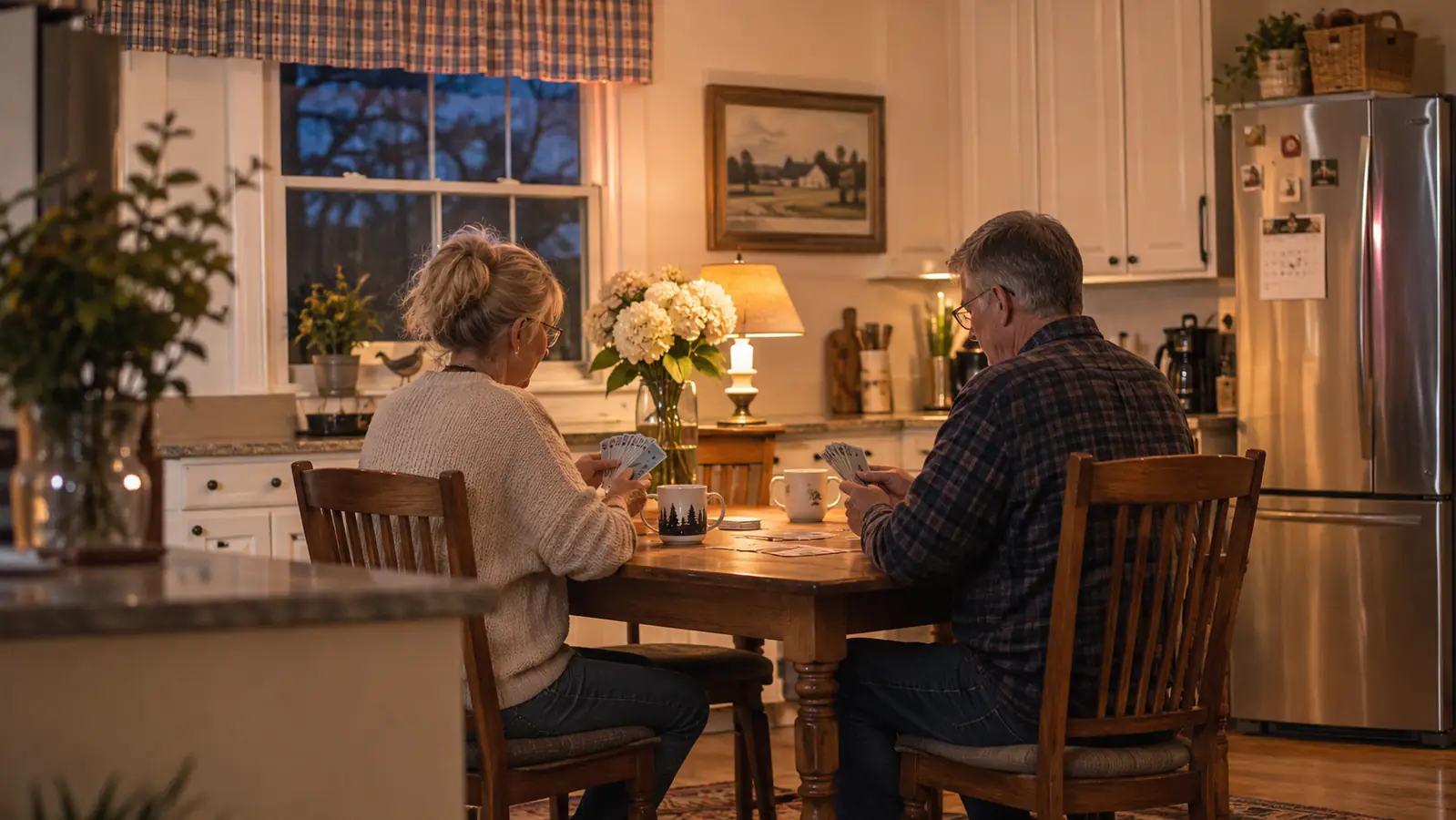
Every Thursday night, the phones go in the kitchen drawer. That was the rule Walt and I set back in the first week of February, after we looked at each other over dinner and realized we had run out of things to say. Thirty-three years of marriage, two kids out of the house, and we had turned into two people eating in front of the television. So we started keeping one night a week for just the two of us, and that same week I bought a little Asmodee box that showed up on the kitchen table. Jaipur, a two-player trading card game about merchants in Rajasthan. Walt rolled his eyes when I opened it. I lost the first game so badly that he still brings it up.
Nine months and about three dozen Thursdays later, Jaipur is still here. That is the part that surprises me. We have tried plenty of date night ideas, and most of them did not survive the month. This little box of cards and tokens is the one we reach for about twice a month, on the nights when there is no movie on the schedule. It is not the loudest or the cleverest thing we own. It is just the one that actually gets two tired people talking again, and that turned out to be worth more than any of the fancier ideas.
The Quick Verdict
The rare two-player game that gets two tired people laughing and trash-talking at the kitchen table, with no rulebook marathon and no screens.
Amazon Check Today's Price →Two Players. Thirty Minutes. Zero Screens.
If your Thursday nights have turned into dinner and a TV show, this is the small fix that worked for us. One little box, a kitchen table, and about half an hour.
Amazon Check Today's Price on Amazon →How I've Used It
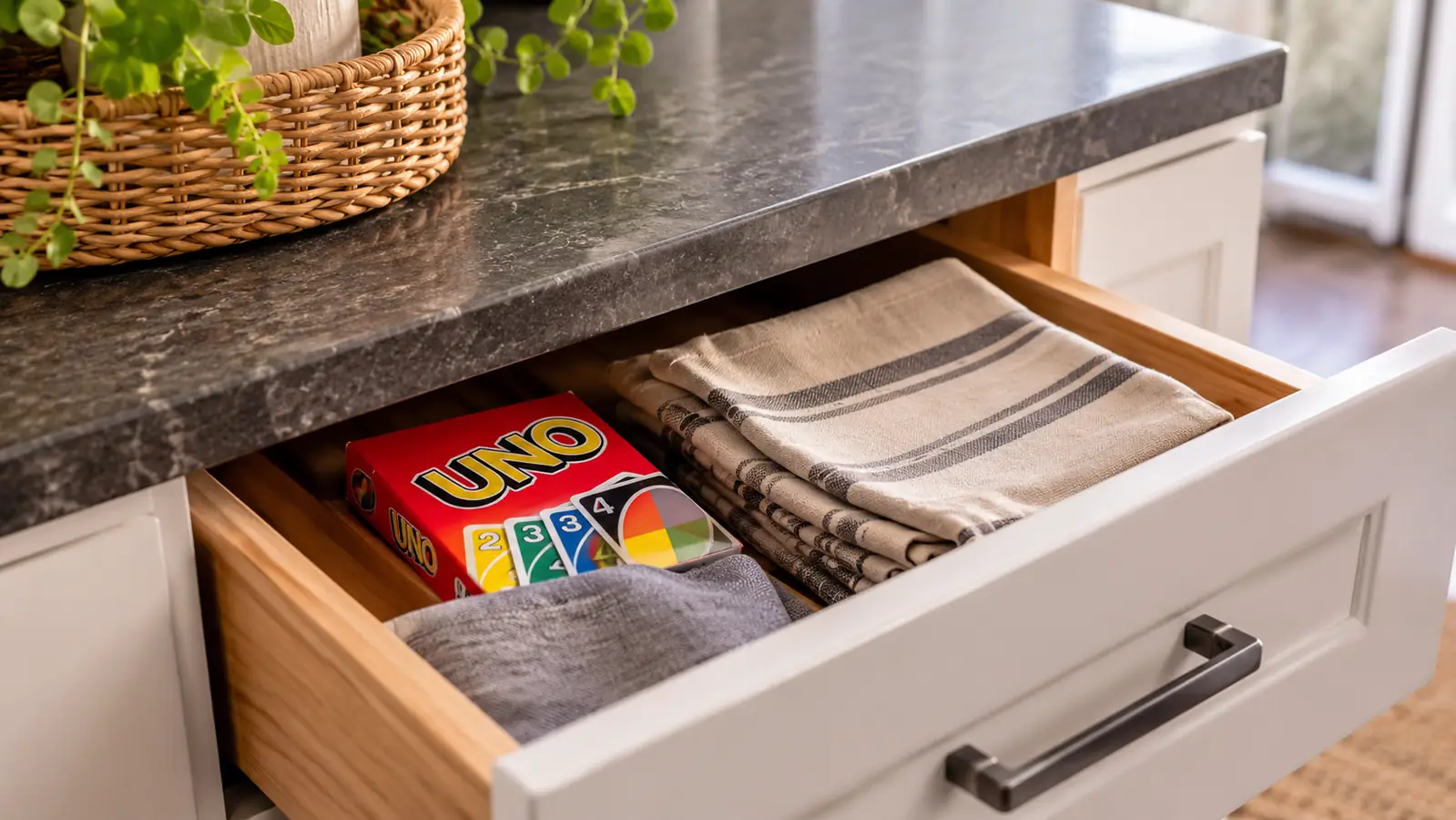
Jaipur lives in the kitchen cabinet with the cloth napkins, and it comes out about twice a month. Walt and I play after dinner at the kitchen table, usually on a Thursday when we are not watching a movie. The whole thing takes about thirty minutes, which matters more than you would think. By the time the dishes are done, we are both tired. A game that needs an hour of setup and a rulebook study session is never going to get played. This one is a small box with cards and tokens, and we can be dealing hands before the coffee is poured.
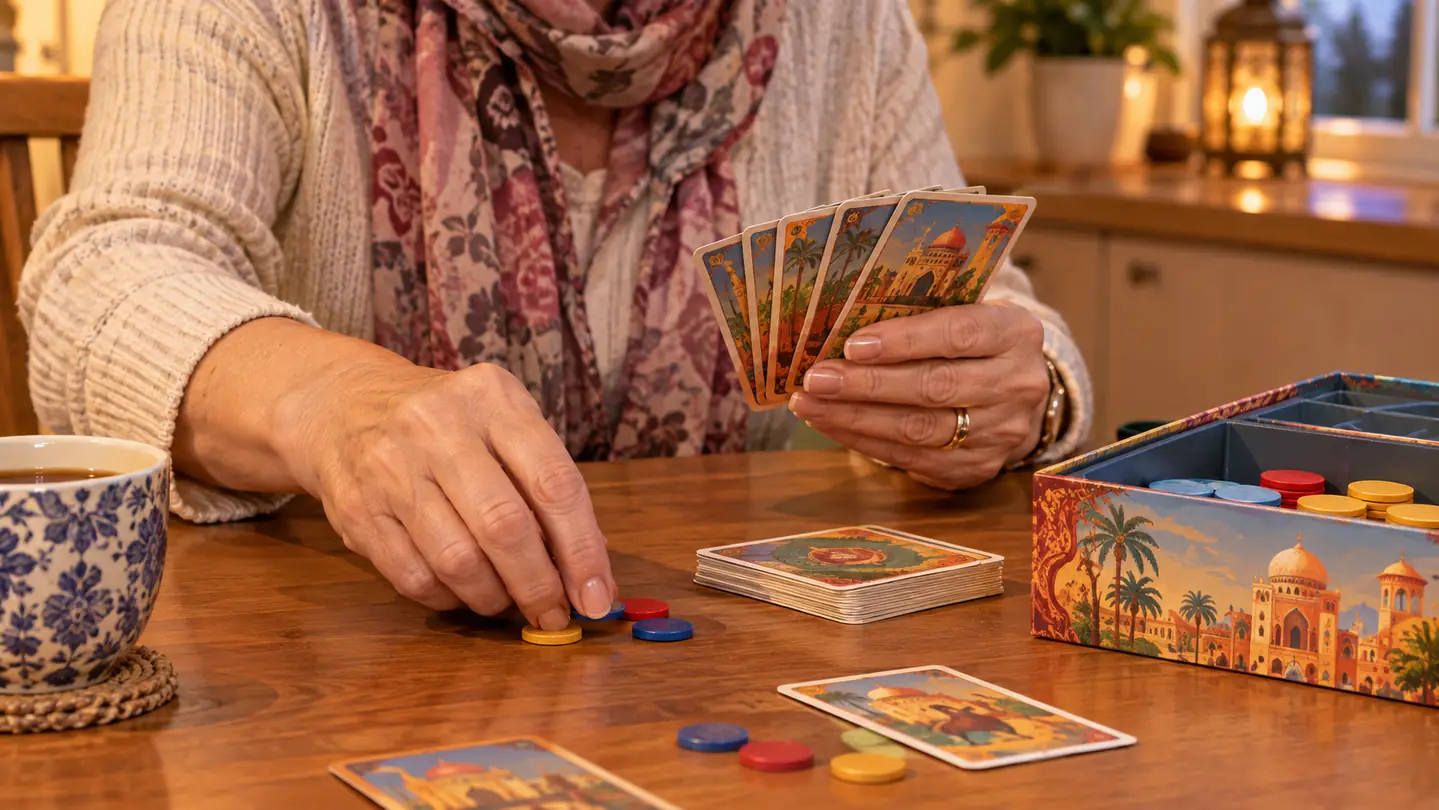
Neither of us thought of ourselves as card game people. Walt's idea of a good evening used to be the recliner and the remote. But Jaipur is built for exactly two players, and the rules are simple enough that we learned by playing. You buy and trade leather, spices, cloth, silver, gold, and precious gems, trying to earn more rupees than the other merchant. There are camels involved, and I still do not fully trust them. The box says the game plays in thirty minutes, and for us it genuinely does, even when we are talking over every move.
Why a Merchant Game Works When You're Both Worn Out
The thing I did not expect is how much the trading actually gives you to talk about. It is a card game, but it is not one of those games where you sit in silence and stare at your hand. Every turn is a decision, and every decision is a chance to needle the other person. When Walt grabs the cloth I was saving, I get to say something about it. When I dump three camels on the market and wreck his plan, he gets to grumble. By the end of the round, we have been talking for thirty minutes without once mentioning the kids, the bills, or the roof.
It also helps that the game does the work of keeping score for us. The box comes with 55 goods cards, 38 goods tokens, 18 bonus tokens, a camel token, and three seals of excellence. That sounds like a lot, but it all fits in the palm of your hand, and the rules fit on a couple of pages. There is no board to hog the table, no app, no timer, nothing to plug in. We clear the dishes, wipe the table, and deal.
The strategy is deeper than it looks. The game description calls it hand management, market timing, and set collection, and I have learned the hard way that those words mean something. You can grab a set of three spices and cash them in for a decent pile of rupees, or you can hold out for five and hope nobody else takes them first. Walt holds out. Walt always holds out. And more often than not, Walt wins.
The other thing I love is that nobody has to be good at games. I am not. My strategy for the first month was to grab whatever looked pretty and hope for the best. It did not matter. The rules are forgiving, the rounds are short, and the game does not punish you for being new. By our third or fourth Thursday, I was making actual plans, and by the second month I was winning the occasional round, which is how I know the game has real depth. You can play it lightly, or you can play it seriously. Both are fun.
What I Learned by Losing (and Losing, and Losing)
Let me be clear about the scoreboard: Walt wins more often than I do. He will tell you it is strategy. I suspect it is luck and a man who has had thirty-three years to learn how I think. The first night, I lost so badly that I made him promise to never tell the kids. He brought it up at dinner the next Sunday anyway. That is the kind of marriage we have.
But here is the thing I did not expect. Losing is still fun, because the games are short and the next one starts fresh. A bad hand in Jaipur costs you maybe ten minutes. You shuffle, you deal, and you get another shot. There is no long, grinding defeat, no hour of watching your plan fall apart. Even on the nights when Walt sweeps three rounds in a row, I find myself wanting one more game, because the next hand is always a clean slate.
I have also gotten better, which helps. I have learned to stop hoarding camels, to watch what Walt is collecting, and to cash in a set before the market turns. The game rewards attention, and attention is exactly what a date night is supposed to be about. When I am watching the market and Walt is watching me, we are both fully present in a way that the television never manages.
Walt rolled his eyes the first night I opened the box. Nine months later, he is the one who asks if we have time for one more round.
How It Holds Up After Nine Months of Thursdays
The honest answer is that it has held up better than I expected. The cards have been shuffled and dealt roughly two dozen times, and they still look new. The tokens are thick and sturdy, the kind that do not bend or fade. Everything lives in the original box, which is small enough to fit in a kitchen drawer, and the lid still closes snug. For a game this small, the build quality has genuinely surprised me.
It is also a game that does not wear out its welcome. Some games get old after you figure them out, because you have seen every strategy. Jaipur has enough luck in the draw that no two rounds feel the same. Walt and I have played enough times that we recognize each other's habits, but the market still throws surprises. The edition we have is the new edition from Asmodee, in English, with standard packaging, and it has been nothing but dependable.
The Honest Tradeoffs
No review from me would be complete without the things that annoy me, because everything has some. Jaipur is strictly a two-player game. That is its whole point, and it is perfect for date night, but it means the box stays in the drawer when the kids come to visit. There is no way to add a third or fourth person, so if you want a game for the whole table, this is not it.
There is also more luck than a serious strategist might like. You can play a perfect hand and still lose because the right cards never showed up. Walt says that is just the game. I say it is how he wins. The truth is probably somewhere in between, and for our purposes it does not matter. We are not training for a tournament. We are two people at a kitchen table on a Thursday night, and Jaipur gives us something to do with our hands and something to talk about.
One more honest note. The tokens are small, and if you play near the edge of the table like we do, you will occasionally knock one onto the floor. We do not have a dog to blame it on, so I have crawled under the table for my share of silver tokens. It is a minor thing, and it has never once made us put the game away.
The Verdict After Nine Months
If I had to sum up Jaipur in one sentence, it would be this: it is the game that made us talk again. Not because it forces conversation, but because it gives two people something pleasant to do with their hands and their heads while the words come back on their own. We did not buy it to fix anything. We bought it because we wanted one more thing to do on a Thursday night besides stare at the television, and it turned out to be the thing that stuck.
Walt still wins more than I do. He still brings up that first disastrous night at the worst possible moments, usually when the kids are over for Sunday dinner. And I still reach for the box every couple of Thursdays, because a game where I lose for thirty minutes is still better than an evening where we do not talk at all. Asmodee has made a lot of games, but this is the one that earned a permanent spot in our kitchen drawer, and that is the honest measure of it.
What I Liked
- Genuinely plays in thirty minutes, even for two slow, chatty players
- Simple enough to learn by playing, with enough strategy to stay interesting
- Small box lives in a kitchen drawer and takes seconds to set up
- Built for exactly two players, which is rare and perfect for date night
- The trading and camel mechanics keep every round different
Where It Falls Short
- Walt wins more than I do, and he is insufferable about it
- Some rounds come down to luck of the draw
- Strictly two players, so it will not work for game night with the kids
- The tokens are small and easy to knock off the table
Who This Is For
Jaipur is for couples who are tired of sitting next to each other on the couch without actually talking. It is for people who want a date night that does not require leaving the house, putting on real pants, or learning a forty-page rulebook. It is for the two of you who used to have things to say to each other and would like to remember what that felt like. If you and your person enjoy a little friendly competition, if you can handle losing without sulking, if you want a game that fits in a drawer and plays in half an hour, this is very likely your box.
It is also worth saying that the box is rated for ages 10 and up, so it is not just for old married folks like us. A couple with teenagers could play it on a school night. Two friends could play it over coffee. But the way we use it, as a small ritual at the end of a long week, it has become one of the best parts of our Thursday nights.
Who Should Skip It
If you want a game with a big board and hours of strategy, this is not it. If you are looking for something to play with more than one other person, this is not it. If you hate any element of luck, if you need to feel in control of every outcome, the card draw will eventually drive you up a wall. And if your idea of a date night is a movie and you are happy with that, you do not need a game at all. Jaipur is for people who want to talk, not for people who want to be entertained in silence.
I would also skip it if you cannot stand losing to the same person over and over. Walt and I are used to each other. We have been annoying each other for thirty-three years. If your relationship is not at that stage yet, a competitive little game like this might bring out a side of you that is not ready for company. Give it a few more Thursdays first.
Give It One Thursday Night
The first night I lost so badly that Walt still brings it up at dinner. We played again the next time anyway. That is the whole review.
Amazon Check Today's Price on Amazon →