
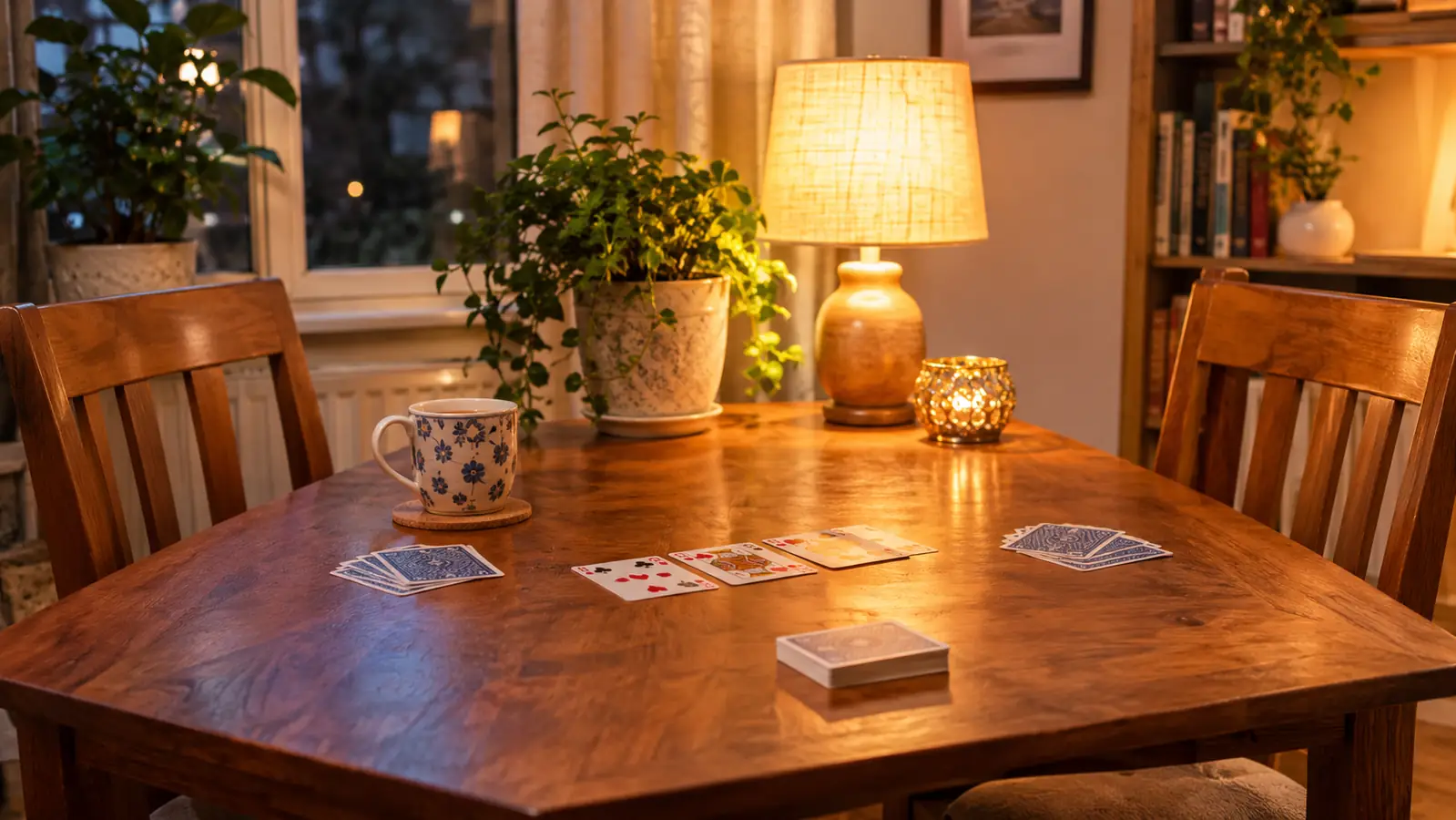
If you want the short answer: for a date night at home, I'd put Jaipur on the table first. It is the game Walt and I actually reach for on Thursday nights, and it is the one I would hand to a couple who wants to talk while they play. Splendor Duel is the sharper, more competitive game, and if you both like to think hard, it might be the better fit. But for two tired people who want to find something to say to each other, Jaipur from Asmodee has been our pick since February.
I'm Paula, by the way. Walt and I started keeping Thursday nights for a date at home back in the first week of February, after our youngest moved out and we realized we had run out of things to say over dinner. The phones go in the kitchen drawer, and after the meal we either watch a movie or play a game at the kitchen table. Jaipur is the game we own. Splendor Duel is the one I have played exactly once, at my sister Denise's house, and I have been comparing the two in my head ever since.
| Jaipur (Asmodee) | Splendor Duel | |
|---|---|---|
| Players | Exactly 2 | Exactly 2 |
| Play time | About 30 minutes | About 30 minutes |
| Learning curve | Explain it in two minutes; the first game flows | A few more moving parts; the board clicks by game two |
| Setup and cleanup | Shuffle the cards, lay out tokens, go | Set up the board, sort the gem supply, arrange the card rows |
| Table footprint | A small pile of cards and tokens | A full board plus a gem supply |
| Strategic depth | Decide when to sell early or hold for a bonus | Three ways to win, blocking moves, and pearl tokens to manage |
| Head-to-head tension | You watch what the other merchant is hoarding | You can grab the exact card your opponent was reaching for |
| Best for | A chatty night where talking matters as much as winning | A night where you both want to think hard and compete |
Where Jaipur Wins
Jaipur is the easier game to get to the table, and on a Thursday night that matters more than you would think. The rules fit on one page: you and your opponent are rival merchants in Rajasthan, buying and trading leather, spices, cloth, silver, gold, and precious gems to earn rupees. On your turn you either take goods from the market or sell a set, and the round ends when the market runs low or the deck runs out. Whoever has the most rupees wins the round, and the whole thing plays in about 30 minutes. I explained it to Walt once, and we played our first full game the same night. I lost badly, and I still wanted to play again.
What makes Jaipur a date night game is that it is chatty. The market changes every turn, so you are always making small decisions out loud, and there is room to talk between moves. We have had some of our best Thursday conversations halfway through a round, with a hand of goods cards in front of us and no idea who is going to win. It also takes up almost no room: a small pile of cards and tokens on the kitchen table, easy to clear when the chocolate comes out. The theme helps too. There is nothing aggressive about haggling over cloth and spices. It feels like playing at a market stall, not like a battle.
Where Splendor Duel Wins
Splendor Duel is the game I played one evening at my sister Denise's house, and I understood why she loves it within the first ten minutes. It takes the gem collecting idea from the Splendor family and builds a whole game around exactly two players. There is a board in the middle, a supply of gem tokens including special pearl tokens, and rows of cards you buy to earn prestige points. What makes it tense is that there are three ways to win: reach 20 points, collect three crowns, or claim 10 points in a single color. You cannot just chase one path and ignore the other two, because your opponent can shut a path down.
It is also a more competitive game. In Jaipur you are both working the same market, and the interaction is mostly watching and guessing. In Splendor Duel you can reach across the board and take the exact card your opponent was about to buy, or grab the last token they needed. Denise and I played one game that evening, and I remember leaning over the board trying to figure out what she was setting up. It is quieter at the table than Jaipur, more like a chess match than a chat. If you and your person both enjoy winning and losing on purpose, that focus is part of the fun. It also looks like an occasion when it is set up, with the board and the gem supply spread across the table.
The Game That Actually Reaches Our Table
Jaipur from Asmodee is the two-player game we have come back to about twice a month since February. It takes two minutes to learn, about 30 minutes to play, and it turns a quiet Thursday into a conversation. If you want a date night game that gets played, this is the one to start with.
Amazon Check Today's Price on Amazon →How I Ended Up Comparing These Two
Back in the first week of February, Walt and I decided Thursday nights were going to be ours. The phones go in the kitchen drawer, and after dinner we either watch something or play something. I bought Jaipur from Asmodee with my own money that same week, because it was built for exactly two players and plays in about 30 minutes, which sounded like exactly what we needed. It has been on the kitchen table about twice a month ever since, on the nights there is no movie.
Splendor Duel came into the picture one evening at my sister Denise's house. She had it set up on her table and talked me into a game, and I could see right away that it was a different animal: bigger, more intense, more to keep track of. I have read the listing carefully since then, and I have thought a lot about which one I would tell a friend to buy for date night. The honest answer is that it depends on the couple, and I want to walk you through how I see it.
What a Thursday Night With Jaipur Looks Like
Here is what actually happens at our house. Dinner is at the kitchen table, and when the dishes are cleared, the Jaipur box comes out maybe twice a month. Walt wins more often than I do, which he enjoys far too much. The box says 30 minutes and it means it, and sometimes we play a second round if the first one was close. The game gives you 55 goods cards, 38 goods tokens, 18 bonus tokens, and a camel token to keep track of the round, and none of it takes up more than one corner of the table.
The part I did not expect is how much we talk during a game. Because the turns are short and the stakes are small, there is space for the rest of your life to wander in. We talk about the kids, about Walt's job, about a recipe one of us wants to try. Somewhere between the leather and the gold, a Thursday that started with nothing to say turns into a conversation. That is the whole point of the night, and Jaipur is the game that gets out of the way and lets it happen.
The other thing I like is that Jaipur does not punish you for being rusty. We have gone three weeks without touching it, and then picked it up again with no trouble. The rules are simple enough that the game comes back to you in one turn. That matters at our age, and it probably matters at yours too.

A Few Practical Notes
One thing that matters more than you would expect is how the game lives in your house. Jaipur comes in a small box, standard packaging, with an English rulebook and a recommended age of 10 and up. It weighs about 231 grams, so it is easy to toss in a bag for a weekend away. The game mechanics are card drafting, hand management, and set collection, which is a formal way of saying you pick cards from a shared market, keep your hand organized, and sell matching sets for a better price. None of that requires a screen, an app, or even a lot of table.
Splendor Duel is also a two-player game that runs about 30 minutes and suits ages 10 and up, but it wants more room. The board, the gem supply, and the card rows spread out, so it feels like a bigger occasion. On a Thursday when we are both tired, that can be part of the appeal or part of the problem, depending on the night. Jaipur asks almost nothing of you before you start. Splendor Duel asks you to lean in. Both are fine answers. They are just answering different questions.
The Verdict After Nine Months of Thursdays
We started these Thursday nights in the first week of February, so we are about nine months and three dozen Thursdays in. In that time, Jaipur has never once felt like a chore. It is the game we reach for when we want company more than competition. Splendor Duel, from my one evening with it at Denise's, is the game I would reach for when we want to actually duke it out. Neither is better. They are for different moods, and a good game shelf has room for both.
If I could only tell you one thing, it is this: do not buy the game that looks more impressive. Buy the game you will actually play on a Tuesday when you are tired, or a Thursday when you have nothing to say. For us, that has been Jaipur. It is the one that gets out of the way and lets the evening happen. And if you both turn out to be the competitive type, Splendor Duel will still be there waiting when you are ready for it.
Who Should Buy Which
Buy Jaipur if you want a game that starts a conversation. It is the right choice for a couple who is tired, who wants to be together without being on, and who would rather talk than study a board. It is also the safer bet if you are not sure your partner is a game person at all. The rules take two minutes, the first game is playable, and nobody has to feel like they are training for a tournament.
Buy Splendor Duel if you both genuinely enjoy strategy and you want a game that feels like a match. It rewards attention, it gives you real ways to block each other, and the three win conditions keep every game interesting to the last turn. If you already play games together and you are looking for something with more bite, that is the one. And if you are still deciding, start with Jaipur. A game that actually gets played beats a game that sits on a shelf, and you can always add the other one later.
Start With the One That Gets Played
A game only works if it reaches the table, and Jaipur has reached ours about twice a month since February. It is easy to learn, quick to set up, and it gives two tired people something to do together that is not the TV. See today's price on Amazon and give your next Thursday night a try.
Amazon Check Today's Price on Amazon →