
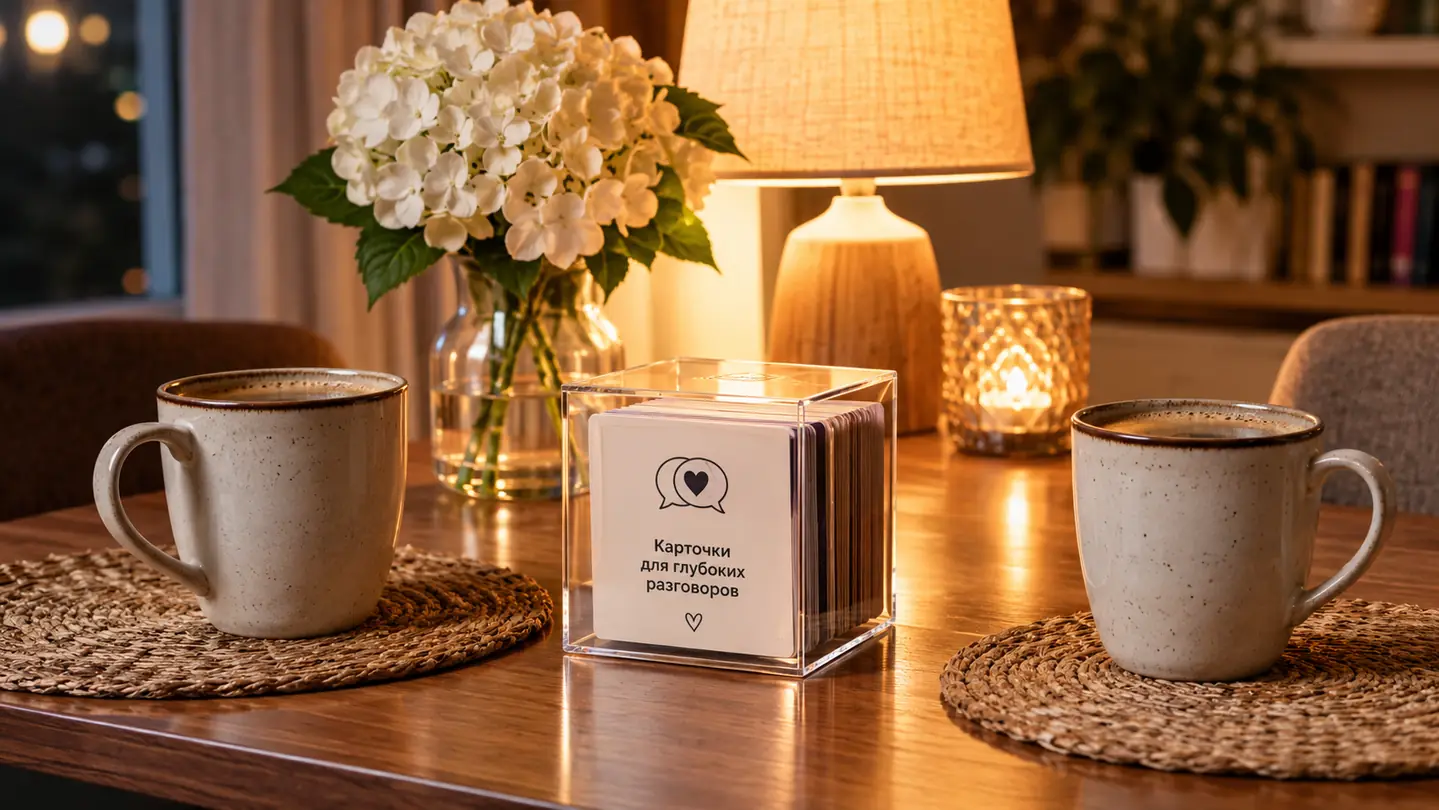
Every Thursday night, Walt and I clear the kitchen table, put our phones in the kitchen drawer, and pull a card from the clear cube that has lived there since the first week of February. The cube is TableTopics Couples, a box of 135 question cards, and it has done more for our conversation than any of the other date night ideas we tried after our youngest moved out three years ago. We started these Thursday nights because we had noticed we were running out of things to say over dinner. That sounds dramatic. It wasn't. It was just quiet. Two people who had talked every day for 33 years, suddenly with nothing urgent to discuss.
I'm Paula, 58, a retired dental hygienist. Walt is 61 and still works full time as an HVAC estimator, so he comes home tired, and I know what tired feels like. The last thing either of us needed was a date night idea that required energy we didn't have. That's why TableTopics won. It is exactly what it looks like: 135 sturdy cards with printed questions, held in a clear plastic cube. You pull one, you read it out loud, you answer. That's the whole product, and that's the whole point. No app, no setup, no score.
The Quick Verdict
A simple cube of 135 questions that gets two tired people talking again. It won't fix a marriage in trouble, but it's the best low-effort habit we've added in years.
Amazon Check Today's Price →The Cube That Got Two Tired People Talking Again
After nine months and about three dozen Thursdays, this is the one date night idea we kept. It lives on our kitchen table, not in a drawer, and once it's there, it costs nothing to use.
Amazon Check Today's Price on Amazon →How I've Used It
We keep the cube on the kitchen table, not in a drawer. That's the whole trick. If it's in a drawer, it won't get used. I know myself well enough to say a drawer is where good intentions go to die. Most Thursday nights, after we clear the plates, we each pull a card or two and take turns answering. Some questions take thirty seconds. Some take the whole meal. Both are fine.
The first night, Walt rolled his eyes. He said it felt like a party game for people who had just met. I didn't argue. I handed him the cube and let him pick the first card. He picked one about what we would do with a free weekend, and by the time he finished answering, the eye rolling was done. He came around within the first month, and now he's usually the one who reaches for the cube before I do.
We don't keep score, and there's no winner. If a question doesn't land, we skip it and pull another. That freedom is why it stuck. A rigid game would have died by March. This one is still on the table in November, about three dozen Thursdays later.
I should also say that we don't do this every single Thursday without fail. Some nights the conversation is already flowing and the cube just sits there, and that's fine. Some nights one of us is too tired to form a full sentence, and we pull exactly one card and call it a success. The cube doesn't demand anything from us. That's why it's still here.

What's Actually in the Box
The whole product is 135 sturdy cards in a clear cube. That's it. No app, no timer, no scoring pad, no booklet of rules that takes an hour to read. The cards are cardstock, the cube is plastic, and the whole thing weighs about 1.4 pounds. It doesn't look like clutter, which matters when it sits on your table every single day.
The questions are written for two adults. The box says 21 and up, and it means it. Nothing racy, but the questions assume you've lived a little. The listing's sample question is, 'Is it our similarities or our differences that attract us to each other?' That's a fair sample of the tone: warm, a little probing, never invasive. You won't feel like you're being interviewed, and you won't feel like you're at a bachelorette party either.
Some cards are about the past, like where we met or what we were like in high school. Some are about the future, like where we'd want to retire. Some are just silly, and those are the ones that get us laughing. The mix is what makes it work. You never know which kind you're going to pull, and that little bit of surprise is enough to keep both of us interested.
The cards themselves have held up well. Nine months of weekly handling, spills near the coffee cups, and the occasional bent corner from a careless thumb, and they still shuffle fine. Cardstock was the right call. I can't say that about every paper product in our house.
Why It Worked When Other Ideas Didn't
Before February, our Thursdays were ordinary dinners with the TV on and our phones out. We weren't in trouble. We were just in a rut. The kids had moved out, and suddenly there were two of us at the table with nothing urgent to discuss. A lot of date night ideas ask for too much setup, or for a better mood than two tired people actually have. TableTopics requires nothing except picking up a card.
The questions do the heavy lifting. When you've been married 33 years, you think you've heard every story. But a good question opens a door you forgot was there. Last month, Walt told me a story about his first job that I had never heard in all those years. It wasn't a big deal. It was just a story that had never come up. That's what this cube does. It makes room for the stories that never made it to the surface.
It also works because it's a ritual, not an event. We don't need a special occasion. The cube is already on the table. On nights when we're both tired, we pull one card and call it a success. On good nights, we go through four or five. Both count, and that's why the habit survived past the first month, when most of our good intentions usually fade.
The First Month Was the Hardest
I want to be honest about the beginning, because the beginning is where most date night ideas die. The first week, it felt like homework. We'd finish dinner, and there would be this little pause where neither of us reached for the cube. I had to be the one to pick it up. Walt was polite but skeptical. He answered the questions like he was filling out a form.
Somewhere in the second or third week, that changed. I think it was the night he asked me a question I had never been asked in my life, something about what I would tell my 25-year-old self. I talked for ten minutes straight. When I finished, Walt said, 'Well, that was worth it.' And that was the moment I knew the cube wasn't going to end up in a drawer.
By the end of the first month, Walt was the one suggesting we pull cards. He'll never admit that in public, but it's true. He says the questions are smarter than he expected, which is his way of saying he was wrong about the whole thing.

The Questions That Surprised Us
Some of the best nights came from questions I would never have thought to ask. There's a card about what you'd change about the way you were raised, and another about the moment you knew your partner was the one. Those are the heavy ones, and we don't always pull them on purpose. But when they come up, we slow down. The cube has a way of serving the question you needed, even when you didn't know you needed it.
Then there are the silly ones, like what superpower you'd want or which famous person you'd invite to dinner. Those matter too. Laughing together at the kitchen table on a random Thursday night is its own kind of glue. I'd argue it's as important as the deep conversations, maybe more, because it's the part we had forgotten how to do.
Honest Notes After Nine Months
Here's what nobody tells you: the questions repeat if you use the box every week. We've been through all 135 at least once, and some cards have come back around. That's not a dealbreaker. We answer differently now than we did in February, and some of our best conversations have come from a repeat card. The first time we answered a question about our biggest adventure together, we talked about a trip to the beach. The second time, we talked about the adventure of raising two kids. Same card, different answer. We've learned to treat a repeat card as a check-in, not a rerun.
The other honest note is that this is not a substitute for real conversation skills. If a couple is in real trouble, a box of questions won't fix it, and I would never claim it would. What it did for us was smaller and more useful. It reminded us how to talk to each other when we had let the habit slip. That's a real thing, but it's not the same as fixing something broken.
One more note: some questions fall flat. Maybe we've already covered that ground, or maybe it's just not our kind of question. We skip those without guilt. The box doesn't care, and neither do we. You have to give yourself permission to skip, or the whole thing starts to feel like an obligation.
What I Liked
- Zero setup: the cube sits on the table, so the habit keeps itself
- Questions are warm and specific, never invasive
- Works on nights when we're both exhausted, which is most Thursdays
- Sturdy cards that have held up to nine months of weekly use
- Walt rolled his eyes at first, and now he's the one who grabs it
Where It Falls Short
- 135 questions do repeat if you use the box every week
- It's a conversation starter, not a fix for couples in real trouble
- Some questions fall flat, and you have to be willing to skip them
Walt told me a story about his first job last month that I had never heard in 33 years. That's what a box of questions can do.
Who This Is For
This is for couples who have run out of things to say over dinner. That's the obvious one. If your evenings have turned into phone scrolling and TV, this is the cheapest fix we found. It's also for newlyweds who want to skip the awkward getting-to-know-you phase, and for long-term partners who want to check in without making it a therapy session. The box is made for 2 players, so it's built for exactly two people at a table.
It's also for anyone who has tried bigger date night plans and watched them fizzle. A fancy evening takes a reservation, a sitter, and energy. This takes a card. On a week when life is heavy, that's the difference between a date night that happens and one that gets postponed until next month. We've had months where the only date night we managed was the one at our own kitchen table, and those are the months that mattered most.
We've also pulled cards on a quiet Sunday afternoon instead of a Thursday night, and it worked just as well. The box doesn't care which night it is. What matters is that two people sit down and actually talk.
Who Should Skip It
If you're looking for a game with points, winners, and competition, this isn't it. There's no score, no timer, and no way to win. It's a conversation starter, not a game, and couples who want a contest will be disappointed. If you need the thrill of beating your partner at something, buy a board game instead.
If you and your partner already talk easily for hours every night, you don't need it. And if you're hoping a product will fix a marriage in trouble, please don't put that weight on a box of cards. It won't carry it, and it shouldn't have to. For us, it did something simpler. It got two tired people talking again, and that turned out to be enough.
The One Date Night Idea We Actually Kept
Nine months in, the cube is still on our kitchen table. If your Thursdays have gone quiet, this is a low-risk place to start. No setup, no score, no pressure. Just one card and one honest answer.
Amazon Check Today's Price on Amazon →