

Somewhere around the ninth or tenth Thursday, I stopped calling it our date night and started calling it the night we actually talk. Walt and I started these Thursdays in the first week of February, after the youngest moved out three years ago and we looked at each other over one too many quiet dinners. The TableTopics Couples cube was the first thing I bought for it, and nine months later it is still sitting on our kitchen table. The question I get most from friends is how it compares to the other deck everyone talks about, We're Not Really Strangers, so here is the honest version.
Short answer: they are both good, and they are not the same kind of good. We're Not Really Strangers is a game you play. TableTopics is a habit you keep. We played the first one exactly once, at my sister Denise's house, and I read the listings afterward to understand what I had just sat through. I have used the cube on about three dozen Thursdays in a row. If you want a structured evening where you and your person go deep on purpose, that is We're Not Really Strangers. If you want two tired people to find something real to say over meatloaf, that is TableTopics. If I had bought both decks back in February, I suspect the game would still be in its box, because a game you have to schedule does not survive a tired Thursday. I will explain the difference, because it is not about which deck has better questions. It is about which one fits the life you actually have.
What Each Deck Actually Is
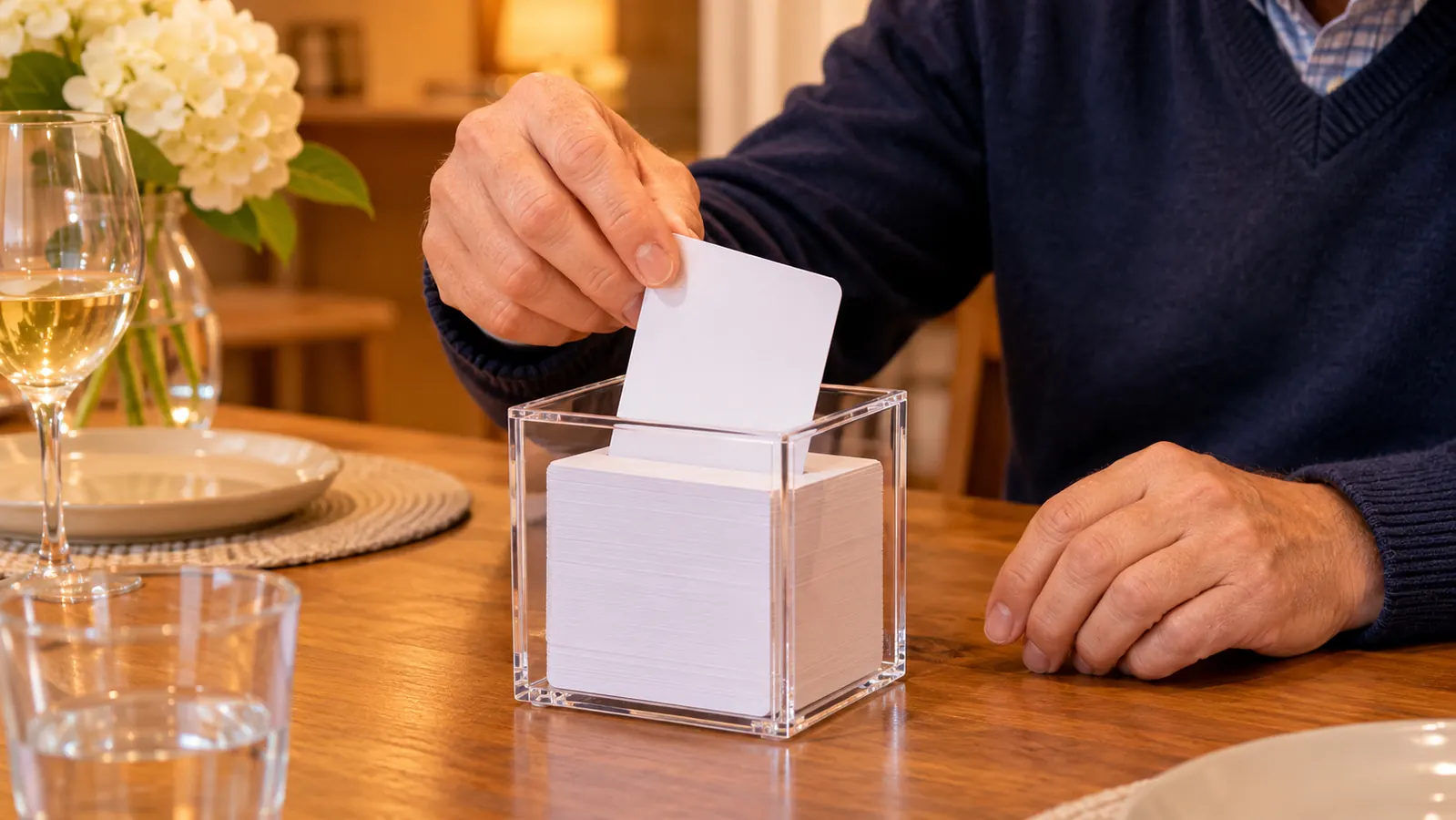
The TableTopics Couples cube is 135 sturdy cardstock cards in a clear plastic cube that lives on the table. You pull a card, read the question, answer it, and put it back. That is the entire instruction manual. The sample question right on the listing is 'Is it our similarities or our differences that attract us to each other?' It is made for two adult players, the box says 21 and up, and it weighs 1.4 pounds, which matters because it has to sit on a kitchen table without being in the way. The questions are not steamy. They are the kind a married couple can answer over dinner without either person feeling put on the spot. Walt rolled his eyes the first night I set the cube down. Within the first month he was pulling cards before I did.
We're Not Really Strangers is a different animal. It has 150 cards arranged in three levels that move from perception to connection to reflection, plus wild cards, and a final level you are meant to play after the game is over. The listing describes it as a game for two or more players, and the levels are labeled right on the box. The card everyone quotes is 'How are you, really?' Denise and her husband brought it out after dinner one night, and I will tell you honestly, it took us about an hour, and some of the questions made the whole table go quiet. It asks more of you. That is not a criticism. It is a description. It is the kind of product that has a following, and after one evening I understood why.
| TableTopics Couples | We're Not Really Strangers | |
|---|---|---|
| Price | Usually the more budget-friendly of the two | Usually sells for a bit more |
| Questions per deck | 135 cards | 150 cards |
| Structure | One deck, pull a card, answer, done | Three levels from light to deep, plus wild cards |
| Fits into a weeknight dinner | One or two cards over a meal, no setup | Wants a full session to work through the levels |
| Packaging | Clear cube that lives on the table | Box you get out when you play |
| Best for | Couples who want a low-pressure talking ritual | Couples who want a structured game night |
How They Feel at the Table
At our house, the cube works because it does not demand anything. On a typical Thursday, dinner is on the table by six thirty, the phones are in the kitchen drawer, and one of us reaches for the cube the way other couples reach for the remote. Some nights we pull one card. Some nights we pull three. The questions are short enough to answer while you are still chewing, which sounds like a small thing and is actually the whole thing. Walt went from rolling his eyes at the cube to pulling cards before I did somewhere in the first month, and now he is the one who notices when a question lands. He will look up from his plate and say 'Huh,' and I know we are not just eating anymore.
At Denise's house, We're Not Really Strangers was a completely different evening. After dinner, her husband cleared the plates and brought out the box like he was dealing a serious card game. We went through the levels in order, and the game has a shape to it. You start light, you get personal, and by the reflection level you are answering questions you would not normally say out loud over coffee. The wild cards change the rules mid-game, which keeps it from feeling predictable. The whole thing took about an hour, and I came home thinking about one of the questions. That is the deck working exactly as designed. It just is not a deck you pull out while the meatloaf is still hot.
Where TableTopics Wins
TableTopics wins the Thursday that actually happens. Walt estimates HVAC jobs all day, and by the time he walks in the door he has been talking to customers and contractors for nine hours. I spent twenty-seven years as a dental hygienist, so I know what it is to come home empty. A date night that requires an hour of concentrated emotional work will lose to the television nine Thursdays out of ten, and I am not going to pretend otherwise. I am not proud of how long we let the TV do the talking, but I am not ashamed of it either. It is just what happens. The cube does not require anything. It sits on the table, and when one of us pulls a card, the conversation has somewhere to go that is not the TV. Some nights one card is the whole date. It is enough.
It also wins on low pressure, and I mean that as a real feature, not a soft one. We're Not Really Strangers has levels, and levels mean you have signed up to go somewhere. Some Thursdays I have that in me. Some Thursdays I do not. The cube does not care. You can pull a question about your similarities and differences and talk about it for two minutes, or you can pull one that keeps you at the table until the coffee is cold. The deck does not grade you, and there is no wrong way to use it. The cube lives on the kitchen table between the salt and the pepper, so it gets used. If you want the longer picture, the TableTopics Couples long-term review on this site tracks how the questions held up over the months, and it matches what we found: a thing you can see gets used, and a thing in a drawer does not.
Nine months and about three dozen Thursdays later, the cube is still on the kitchen table, and we still pull cards most weeks.

Where We're Not Really Strangers Wins
Now the honest part, because a comparison where my deck wins every row is not a review, it is a commercial. We're Not Really Strangers wins on depth, and it is not close. The three levels are engineered to take you somewhere. Perception questions are light and observational. Connection questions get personal. Reflection questions land hard, and the final level, the one you read after the game is over, is the part people remember. At Denise's house, the question that made the whole table go quiet was the famous one: 'How are you, really?' It is four words, and the silence after them was not awkward. It was the kind of silence where everyone is actually thinking about the answer.
It also wins for couples who want a deliberate, structured evening. If you are newly dating, newly engaged, or going through a season where you both know you need to talk about something specific, a deck that guides you through levels is a gift. It does the work of a trail guide. You know where you are going, and the structure carries you past the small talk you would otherwise hide in. With 150 cards, it also edges out the cube on volume, and the production feels designed from the ground up. I have played it exactly once, at my sister's house, and I read the listings afterward to understand what I had sat through. I cannot tell you what a year of owning it looks like. I can tell you that one evening stayed with me, and that is exactly what it was built to do. Denise read the final level card after the game, and I will not repeat what it said here. Some things are better discovered at your own table.
The deck that actually got used on our Thursdays
Nine months in, the TableTopics Couples cube is still the first thing on the kitchen table every Thursday. No setup, no rules to explain, no level to reach. Just pull a card and answer it. If you want a low-pressure way to start talking again, this is the one that worked for us.
Amazon Check Today's Price on Amazon →Who Should Buy Which
Buy TableTopics Couples if you are a couple like us: tired at the end of the day, not in crisis, just aware that dinner got quiet somewhere along the way. It is for people who want a habit, not a production. It is for the skeptical partner, because the cube does not ask for a game night. It just sits there until someone pulls a card. The first card is the hardest part, and after that it stops being a thing you try and starts being a thing you do. If you want the case for conversation cards laid out one by one, the list of ten reasons conversation cards work for couples on this site covers it better than I can in a paragraph. And if you are buying a gift for a couple you love, the cube is the safer present, because it does not assume anything about where their relationship is.
Buy We're Not Really Strangers if you and your person want a game night with a shape to it. If you are newer in a relationship and still building the habit of hard questions, or if you are long-term and going through something you both know needs air, the three levels will carry you further than a random pull from a cube. It asks for an hour and a willingness to go deep. That is a feature, not a flaw. It just was not what our Thursdays needed. We needed the cube. Some couples need the game. And if you are the couple that already talks easily, you may not need either one. But most of us need a little help now and then, and there is no shame in that.
The Bottom Line
The bottom line is that these are two good decks with two different jobs. We're Not Really Strangers is the deck you schedule. TableTopics is the deck you live with. If your problem is that you never get around to the big conversation, the game will get you there. If your problem is that you and your person have run out of things to say over dinner, the cube will turn that around one quiet Thursday at a time. Ours took about nine months and three dozen Thursdays, and I would not trade a single one of them.
Start with one card over dinner tonight
The cube is the easy first step. One card, one honest answer, and the quiet dinner starts to turn around. That is how it went for us, and it can go that way for you.
Amazon Check Today's Price on Amazon →