

Walt and I have been married 33 years, and last winter we hit a stretch where dinner got quiet. Not angry quiet. Just the kind of quiet that happens when two people have already told each other everything they thought there was to tell. He would come home from estimating HVAC jobs, I would put supper on the table, and we would eat like roommates. The phones came out more than the conversation did. One night I looked across the table and realized we had been sitting there for ten minutes without either of us saying a word. That is when I admitted to myself that we had run out of things to say over dinner. That is why, in the first week of February, I bought a clear cube of question cards called TableTopics Couples and set it on the kitchen table. I did not tell Walt I bought it. I just set it down with the salt and pepper and waited to see what he would do.
This is the honest version of what happened next. The first night, Walt rolled his eyes at the cube. Within the first month, he was the one reaching for it. About nine months and roughly three dozen Thursdays later, we still pull a card or two over dinner almost every week. I am not a therapist and this is not a lecture. I am just a woman who found a small thing that worked, and I want to tell you exactly how we did it, one step at a time. It took one eye roll, one quiet answer, and one conversation we had not had in years.
Put the cube on the table and see what happens
TableTopics Couples comes with 135 sturdy cards in a clear cube, made for two players. Ours has sat on the kitchen table since February, and it is the simplest thing we added to date night. It is also the one that worked.
Amazon Check Today's Price on Amazon →Step 1: Pick a night and put the phones in the drawer
Our date night is Thursday. It has been every Thursday since the first week of February, and it is not negotiable, not for a late job, not for a show we want to watch. The rule that makes it work is simple: before supper, both phones go in the kitchen drawer. Not on the counter, not face down on the table. In the drawer. The first few weeks, Walt's hand went to his pocket out of habit. Now he reaches for the drawer at the same time I do, and the phones stay there until the dishes are done. That drawer rule matters more than the cards do, honestly.
You do not need a fancy night out to make this work. We live in a single-story brick ranch in Maryville, Tennessee, and our date night happens at the kitchen table, every single week. The setting is not the point. The point is that both of you know Thursday is coming. When a night is marked, you stop letting the silence win by default. We are not night owls, so an early supper works better for us than a late dinner out ever did.
If Thursday does not work for you, pick any night. The important part is that it is the same night, and that it belongs to the two of you. Routine is what turns a good idea into a habit.
Step 2: Put the cube where you cannot ignore it
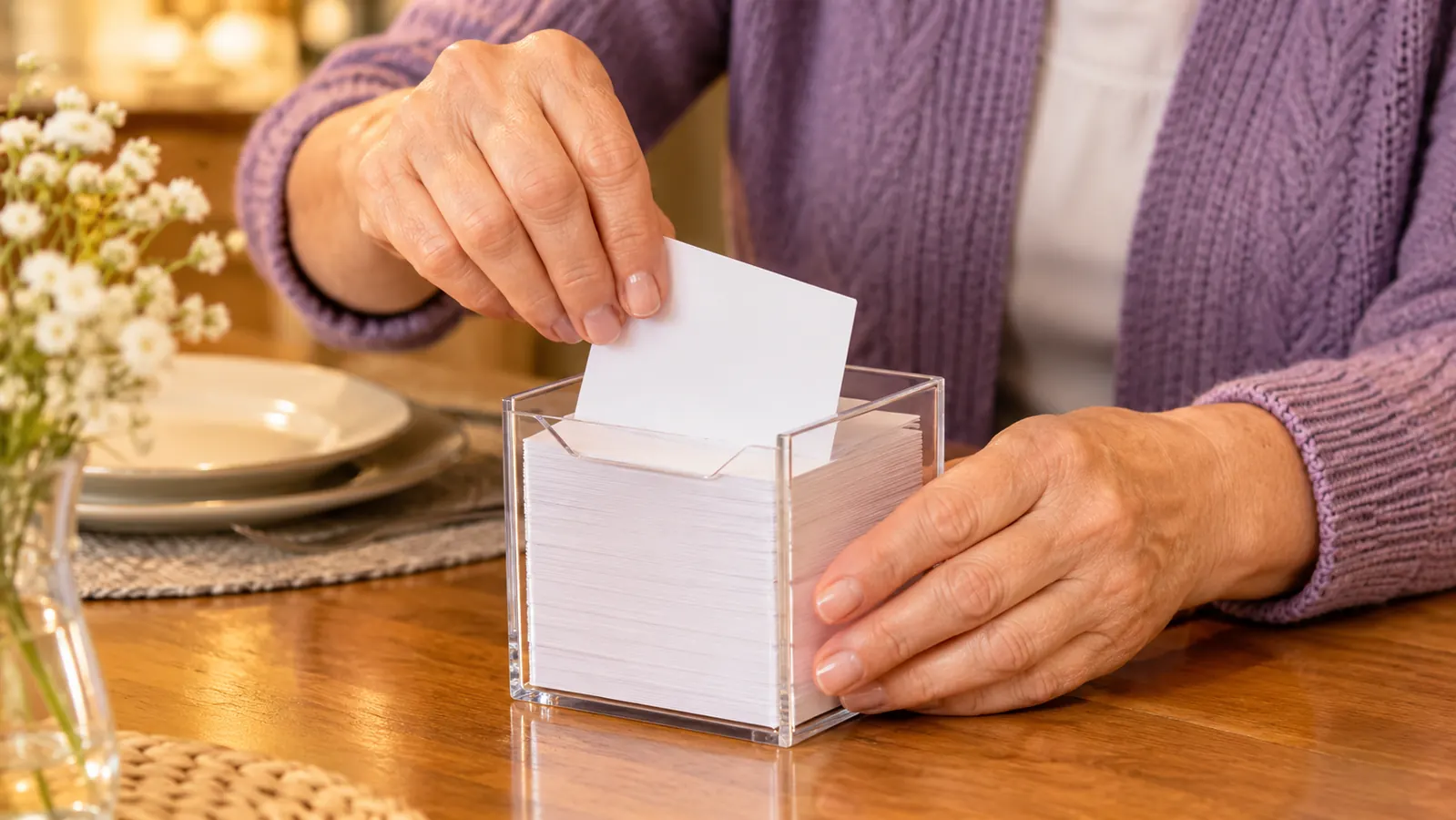
The TableTopics cube weighs 1.4 pounds and it lives on our kitchen table, between the salt and the pepper. Not in a cabinet. Not on a shelf. On the table. That placement matters more than it sounds like it should. When the cube is already there, you do not have to decide to have a conversation. You just reach for it. Out of sight is out of mind, and out of mind means another quiet dinner.
The set is made for two players, and the cards are sturdy cardstock with printed questions, held in a clear plastic cube. The box says it is for adults 21 and up, which made Walt laugh the first night. He said, "I have been an adult for forty years, I think I can handle a card game." Then he pulled a card and went quiet reading it. I did not push. I just waited. He read it twice before he said anything.
That quiet was not annoyance. It was thinking. The first question he pulled took him a minute to answer, and when he did, it was not the answer I expected. That minute is the whole reason I bought the thing.
Step 3: Pull one card each and answer like you mean it
The card I remember best from the first month is the one printed right on the listing: "Is it our similarities or our differences that attract us to each other?" You would think after 33 years I could answer that without thinking. I could not. Walt answered first, and his answer surprised me. That is the whole trick of these cards. I still do not know if I would answer it the same way I would have ten years ago.
You do not have to answer every card, and there is no score, which is exactly why it works. The box says two players, and the questions are meant for married couples, long-term partners, newlyweds, even relationship therapists. We are just a retired dental hygienist and a tired HVAC estimator, and it works for us. Each of us pulls a card or two over dinner, and the other one actually listens. No one is grading the answers. That is what I mean by low stakes.
The questions are not therapy and they are not gotchas. They are open doors. Some nights we answer one card and then talk about the yard for twenty minutes. That is fine. The card did its job the moment it got us talking.
Step 4: Let one answer lead somewhere
The mistake I made at first was treating the cards like a checklist. Pull, answer, pull again. Somewhere in the first month I learned to stop after one good answer and ask a follow-up. "Wait, really? Why did you think that?" That follow-up question is where the real conversation happens. The card gets you started. The follow-up is what turns an answer into an actual talk. It sounds simple, but it took me weeks to learn.
One night Walt pulled a card about a memory from our early years, and his answer turned into a story about his first job that I had never heard. Thirty-three years of marriage, and there are still stories I have not heard. That is what the cube is actually for. It is not the conversation. It is the door. Some nights I still catch myself surprised by what he says.
If an answer lands flat, let it go. Pull another card, or let the silence sit for a minute. Not every question is going to hit. The ones that do are worth waiting for.
Step 5: Keep it low stakes and keep showing up
Walt rolled his eyes at the cube the first Thursday. By the third or fourth week, he was the one reaching for it. Now, about nine months and roughly three dozen Thursdays in, it just sits there and we use it most weeks. Some weeks we pull two cards each. Some weeks we pull one and then talk about our son and daughter, or the trip we are half planning. The cube does not have to do all the work. It just has to get us started. The habit is the thing. The cards are just the excuse.
The reason this worked is that we never made it a big deal. It is a box of cards on a table. There is no right way to use it, no score, no goal. The only rule is that Thursday belongs to us and the phones stay in the drawer.
If you are in the same spot we were, the spot where you have run out of things to say over dinner, start there. One night, one cube, one card. The rest takes care of itself.
What the Cube Actually Changed
I want to be straight with you about what this did and did not do. TableTopics did not fix our marriage, because our marriage was not broken. It did not turn us into people who have deep talks every single night. Some Thursdays we pull cards and some Thursdays we pull one and then get distracted by a show on the 55 inch TV in the living room. The cube is not a guarantee. It is an invitation. I want you to know that before you buy anything.
What it did do is give us a way back to each other on the nights when we had nothing to say. It made the first move so we did not have to. That sounds small, but small is exactly what a tired couple needs. You do not climb out of a rut in one dramatic evening. You climb out one Thursday at a time. That is the honest review part of this whole guide.
The cards are just cardstock and plastic. The conversation is on us. But the cube is the reason the conversation starts, and that is worth more than I expected.
The other thing I did not expect: the cube made us better at sitting with silence. When you know a question is coming, you stop rushing to fill every gap. You let the other person think. That is a skill, and we practice it every Thursday.
What Else Helps
We did not change everything at once. The cube was the first thing, and it is the thing that stuck. But a few small additions made the Thursday habit easier to keep.
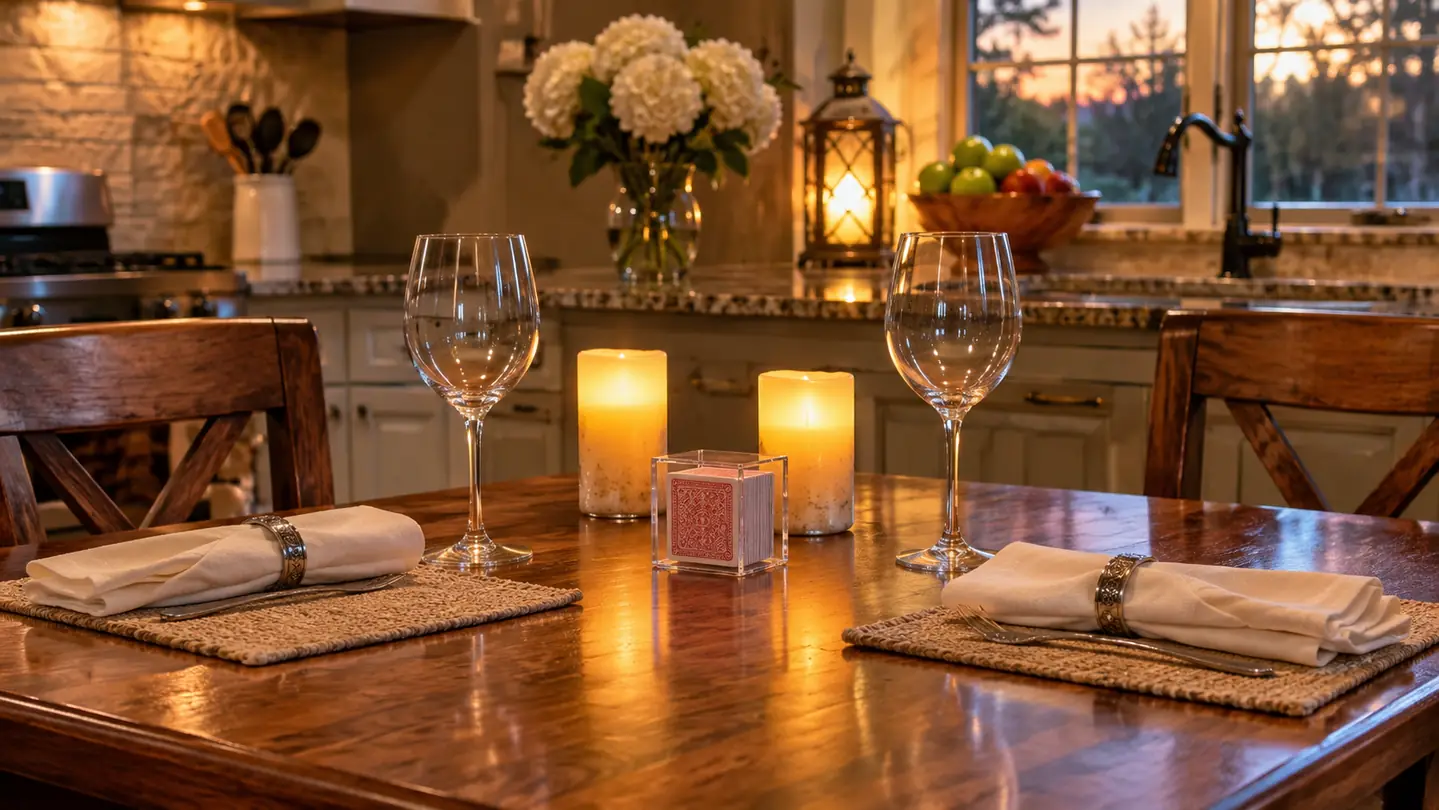
The flameless candles on the table and the windowsill help more than I expected. I used to worry about real wax candles near the kitchen curtains, so I switched to flameless ones that turn on with a remote. They make the kitchen feel like a date instead of a pit stop. It sounds like a small thing, but small things are the whole point of a Thursday night at home. They have been on that table every Thursday since February.
About twice a month, we pull out the fondue pot and do cheese fondue with broth, then chocolate for dessert. Fondue is slow by design, and slow is good when the goal is talking. The TableTopics cube stays on the table during fondue nights too. The broth version means we can both have a second helping without feeling weighed down.
The other thing that helps is not a product at all. It is deciding that you are not going to fix anything. When Walt tells me about a rough day at work, my job is to listen, not to solve it. The cards taught me that. You cannot put that in a box, but it is the part that actually matters. It took me about fifty years to learn that, but I got there.
And if you are wondering whether the cards are worth it when you already know each other's life stories, that is exactly the point. The questions are not about facts. They are about how you feel about the facts. That is a different conversation, and it never runs out.
Walt rolled his eyes at that clear cube the first Thursday. By the third week, he was the one reaching for it.
Keep the conversation going past dessert
Nine months in, we still pull cards most Thursdays. If your dinner table has gone quiet the way ours did, this is a small, low-pressure place to start. One cube, one night, one card at a time.
Amazon Check Today's Price on Amazon →