

Here is the scene I was dreading when we started our Thursdays. I pictured Walt and me clearing the dinner plates, one of us saying, "Want to try a game?" and the other saying "Sure," and then the two of us sitting there for twenty minutes trying to learn the rules from a booklet that assumed we already knew what a 'setup phase' was. By the time we actually started playing, one of us would have sighed, and the other would have said "Never mind."
That is the evening I wanted to avoid when I found the Asmodee Jaipur game. It is a 2-player trading card game that plays in about 30 minutes, and it is the first game we have taught each other without anybody getting huffy. I taught it badly the first time and better the second, and I have a few notes on what actually works. If you want a date night at home that ends with both of you talking instead of sulking, here is how we do it.
The 30-minute card game that finally stuck at our kitchen table
Asmodee Jaipur is built for exactly two players, which means nobody is waiting for a third person to show up. It takes about 30 minutes a round, it is easy to learn in one sitting, and it has held up through about nine months of Thursday nights at our house.
Amazon Check Today's Price on Amazon →Step 1: Play the first round with both hands open
The biggest mistake I made the first night was treating the game like a test. I read the rules, I felt confident, and then I sat across from Walt and said "OK, you'll pick it up as we go," which is the most unfair sentence in the English language. Nobody picks up a trading game as they go. Walt spent the first round confused and grumbling, then caught on and beat me badly anyway, and neither of us had much fun. That first night was the first Thursday in February, and I remember thinking, as he put the box back in the cabinet, that I might have just spent money on a game we would never play again.
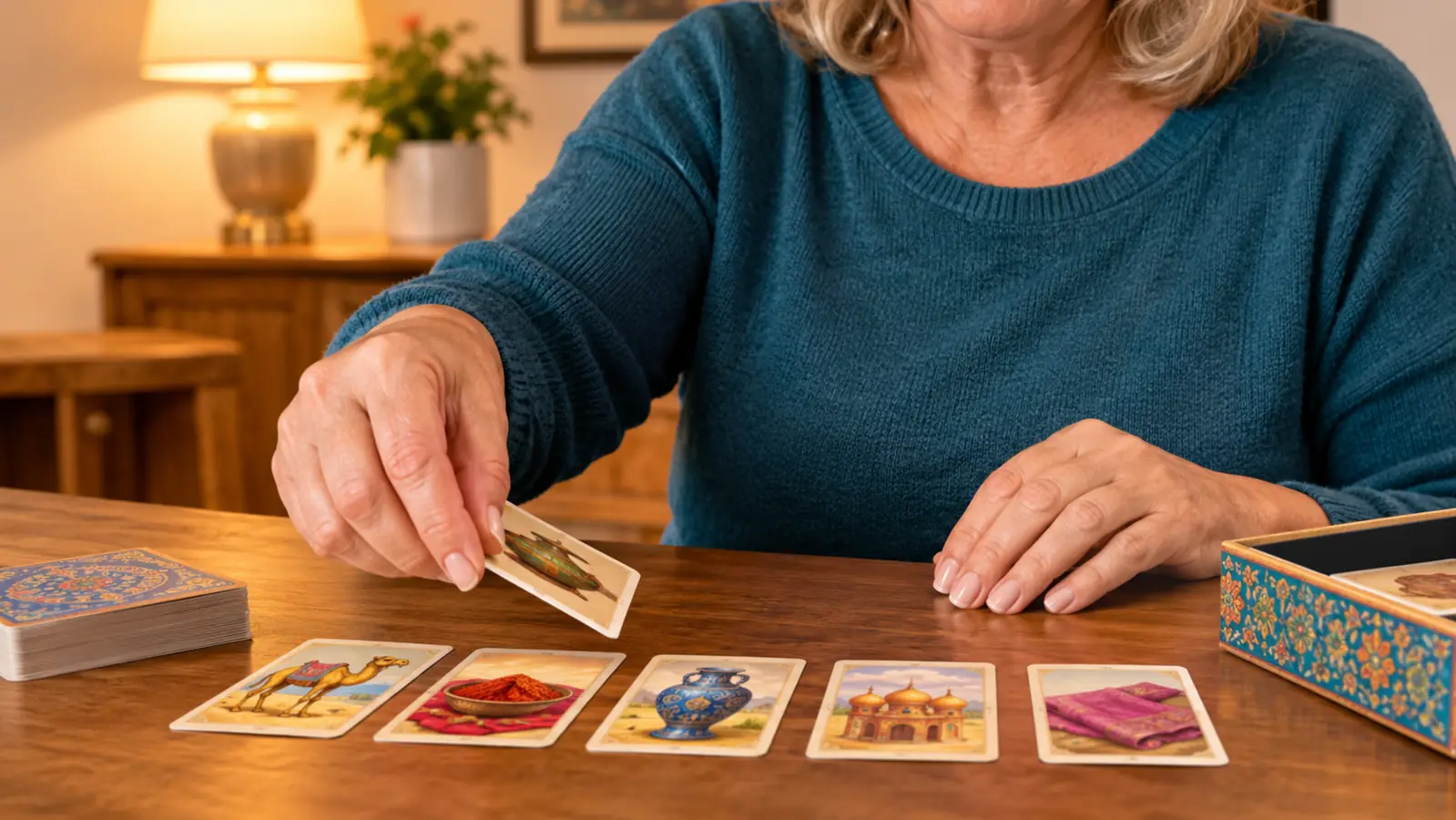
The fix is to play the first round with both hands open. In Jaipur, each player starts with a hand of goods cards, and there is a market row of five face-up cards in the middle. Instead of hiding your hand, lay it face-up on the table and talk through every move. Say "I am taking the two leather cards because I can trade them for a camel," and let them do the same. The first time we tried this, Walt pointed at my hand and said "Why would you ever keep silver?" and I had to admit I did not know yet. That question taught us more than the rulebook did. You are not playing to win the first round. You are playing to learn the rhythm.
This is where the Asmodee Jaipur design earns its keep. The whole game is card drafting, hand management, and set collection, which sounds complicated until you see it happen once. When both hands are open, the rules stop being abstract. Your spouse sees why you grab three cloth cards or why you leave the silver alone, and by the end of the first round, the game makes sense. We played our open-hand round on the second Thursday in February, and Walt asked to play again the same night, which had never happened with any other game.
Step 2: Teach the scoring with one example, not the whole rulebook
The Jaipur rules are not long, but they are dense in one spot: scoring. You collect sets of goods, and bigger sets are worth more rupees. You also get a bonus token when you are the first to deliver three, four, or five of a kind. If you try to explain all of that at once, you will watch your spouse's eyes go glassy, and you will have lost the night. I know, because I watched Walt's eyes go glassy on the first Thursday in February, somewhere around the part about the seals of excellence, and I kept talking anyway.
So do what I do now. Set up a tiny fake round and show them one example. Put three cloth cards in front of you, point to the cloth tokens, and say "Three cloth is worth five rupees, plus a bonus token for being first to three." Then put five gold cards in front of them and say "Five gold is worth a lot more, but it takes longer to collect." That is the whole lesson. The rest of the scoring they will absorb over the first two real rounds. When we did this, Walt looked at the five gold cards, counted the tokens, and said "So the slow play is the smart play." He had the whole game in one sentence.
I have learned that Walt does not need to know every rule on the first night. He needs to know that the game rewards patience and that I am not going to be smug when I win. The Asmodee Jaipur rulebook is actually written clearly, which helps, but the person holding the booklet is still the teacher. Keep the lesson to one example and let the game teach the rest. The box lists 55 goods cards, 38 goods tokens, 18 bonus tokens, 1 camel token, and 3 seals of excellence, and none of that matters until somebody has played a round and seen what the pieces do.
Step 3: Lose the first real game on purpose, and do not be obvious about it
Here is the part nobody puts in the instructions. If you are the one who suggested the game, you should probably lose the first real game. Not by playing terribly, and not by making a big show of it. Just make one slightly impatient trade near the end, when you have a choice between a safe move and a risky one. Take the risky one. Let it fail. Say "Ah, I should have traded the silver," and mean it. I did exactly that on the third Thursday in February, swapping away a set of gold I had been quietly building because I wanted the camel token on the table.
I am not saying this to be sneaky. I am saying it because the first real game is about building your spouse's confidence, not about proving who is better at collecting camels. When Walt won his first real round of Jaipur, he sat up a little straighter and said "OK, I get it now." That one win did more for our Thursday nights than any rule explanation I have ever given. He talked about that game for the rest of the evening, and the next Thursday he asked if we could play before I even mentioned it.
And here is the honest part: you will not have to lose very often. The Asmodee Jaipur game has real depth. The market changes every turn, the camel tokens matter more than you expect, and a player who lost the first round often wins the second. Walt wins more than I do now, and I am not even sure I am letting him. That is the sign of a good game. It stays interesting for both of us. Somewhere around the fifth or sixth week, he started pointing out my mistakes before I made them, which is annoying and also exactly what I wanted.

Step 4: Keep the first session to one round and stop while it is fun
The fastest way to start a fight over a new game is to play too long. The first time we tried a different card game, we played four rounds in a row, and by the third round we were both tired and snippy. By the fourth, we were playing to win instead of playing to have fun. I do not recommend it. We put that game in the donation box the next weekend, and I do not even remember its name now.
With Jaipur, we keep the first session to one round. One round of Jaipur takes about 30 minutes, which is the perfect length for a Thursday night after dinner. When the round ends, we put the cards back in the box and talk about what we would do differently next time. That conversation is the real date. The game is just the thing that gives us something to talk about. On the nights we play, we are usually back in the living room by 8:45, which means the evening still has room for a show or just sitting on the porch.
The Asmodee Jaipur game is built for this. It is a 2-player strategy game with an estimated playing time of 30 minutes, and it is designed for ages 10 and up, which means two adults in their late fifties can handle it just fine. The components are simple: 55 goods cards, 38 goods tokens, 18 bonus tokens, 1 camel token, and 3 seals. Everything fits back in the box in under a minute, which matters more than you would think. The box itself is small enough to live on the shelf between the TableTopics cube and the fondue pot, so it is never out of sight and never out of mind.
Step 5: Make it a ritual, not a one-time event
The reason Jaipur worked for us is not the game itself. It is that we made it part of a routine. Every Thursday night, the phones go in the kitchen drawer, we eat dinner at the kitchen table, and about twice a month, after the dishes are done, we pull out the Jaipur box. It is not a special occasion. It is just what we do. We started the whole date night habit in the first week of February, and Jaipur has been on the table about twice a month ever since.
That routine is why the game finally stuck. The first time we played, I was nervous and Walt was skeptical. The second time, we both knew the rules and could actually talk while we played. By the third time, we were trash-talking each other's camel trades and laughing about it. A game that only comes out on vacation never gets that chance. Now, nine months in, the box has a slightly worn corner, and Walt knows which goods are worth hoarding, and I still lose more than I win, and I am fine with all of it.
So my real advice is this: do not try to make the first night perfect. Play one round, lose gracefully, put the box away, and schedule the next Thursday. The Asmodee Jaipur game will still be there, and so will your spouse. That is the whole trick. The best game for a date night at home is not the cleverest one on the shelf. It is the one you will actually pull out again, and Jaipur is the one we keep pulling out.
What Else Helps
A few things we learned that have nothing to do with the rules. First, play at the kitchen table, not on the couch. The kitchen table is where we already talk, so the game feels like an extension of dinner instead of a separate activity. Second, keep a small notepad nearby for scores, because nobody wants to argue about who won the last round. Third, do not play when you are actually hungry or actually tired. A 30-minute game is forgiving, but it is not magic. We learned that the hard way one Thursday in March when Walt came home from a long estimate and I tried to teach him a new round anyway. We stopped after ten minutes and watched TV instead, and that was the right call.
We also learned that the game works best when we do not turn it into a competition. Walt and I keep a running tally in our heads, but we never make a big deal about who is ahead. The point is the hour we spend together, not the rupees. If you keep that in mind, Jaipur will do exactly what it is supposed to do: give two people something fun to do with their hands and their brains while they talk. And when the round is over, we have something to talk about that is not the kids, not the bills, and not the roof.
Walt won his first real round of Jaipur, sat up a little straighter, and said, 'OK, I get it now.' That one win did more for our Thursday nights than any rule explanation I have ever given.
One round, one table, one happy spouse
If you want a date night at home that does not end in a rules argument, Jaipur is the game we reach for. It plays in 30 minutes, it is built for exactly two players, and it has survived about nine months of Thursday nights at our house. That is the highest compliment I can give a card game.
Amazon Check Today's Price on Amazon →