

I will tell you the part nobody puts in the product photos: the first time Walt and I played Asmodee Jaipur, I lost by a lot. Not a close game. Not a respectable near miss. He cornered the market on silver, I held a hand full of leather nobody wanted, and the scoring tokens told the whole story. I laughed, he grinned, and then he asked if we could play again. That is the honest review of Jaipur in one sentence. It is a game that makes you want a rematch, even when you are the one getting beat.
We bought it in the first week of February, the same week we started keeping Thursday nights for a date at home. About nine months and roughly three dozen Thursdays later, Jaipur is one of the five things that actually stuck. It does not appear every Thursday. It appears about twice a month, after dinner at the kitchen table, on the nights there is no movie. And because I promised myself I would tell you the good and the not so good, I am going to do exactly that.
The Quick Verdict
A two-player trading game that gets two tired people talking and trash-talking in 30 minutes, as long as you do not mind losing to your spouse.
Amazon Check Today's Price →The game that made Walt ask for a rematch
Asmodee Jaipur is a 30-minute, two-player trading card game that has earned a spot on our kitchen table about twice a month since February. If you and your person are tired of the same dinner conversation, this is the easiest way we have found to change the subject.
Amazon Check Today's Price on Amazon →What Jaipur Actually Is
Jaipur is a two-player card game from Asmodee. You are rival merchants in Rajasthan, buying and trading leather, spices, cloth, silver, gold, and precious gems, then selling them for rupees. The player with the most rupees at the end of the round wins the round. The first player to win two rounds wins the game. The box says it plays in about 30 minutes, and in our experience that is exactly right. Some nights we finish in twenty. Some nights we stretch it closer to forty because we are both trying to figure out whether the other one is bluffing.
The game mechanics are card drafting, hand management, and set collection. That sounds like a lot of words. What it means at our kitchen table is this: you look at the market of five face-up goods cards, you decide whether to take one, trade a few from your hand, or grab the camel, and you try to figure out when the other person is about to dump three spices at once. It is a game about timing more than luck. The cards you hold matter less than knowing when to sell them.
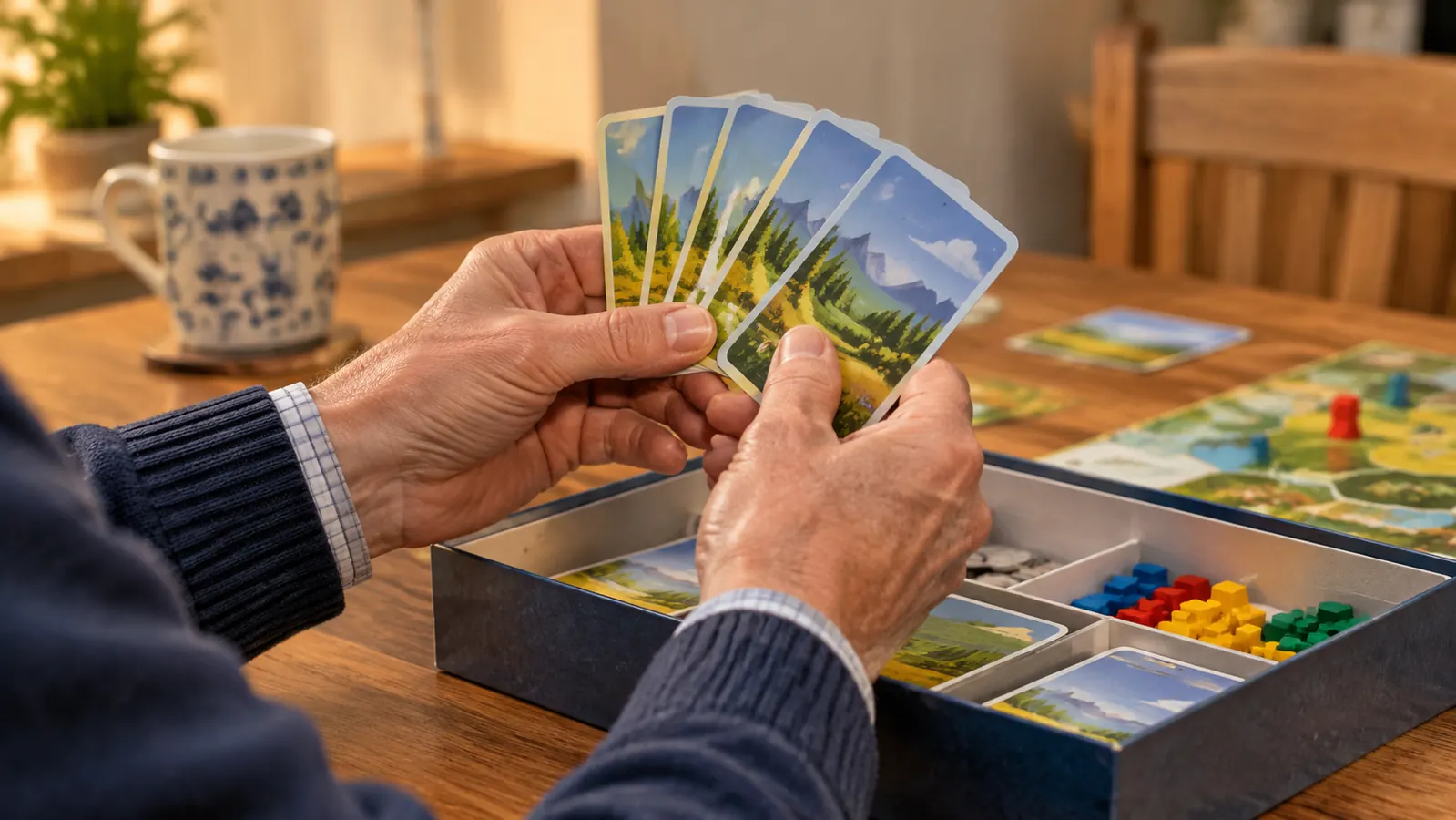
Here is what a turn actually looks like at our table. Five goods cards sit face up in the middle. On your turn you can take one of those cards, take all the camels in the market, or trade cards from your hand for cards in the market. When you have a set of the same good, you can sell them: three cloth cards for a small payout, five gold cards for a big one. The trick is that bigger sets are worth more per card, so you are always deciding whether to sell now or hold out for a better price. One Thursday in March, I held three silver cards for four turns, watching the market, convinced Walt would not touch silver. He took the silver right before I could sell, and I learned the lesson every Jaipur player learns: you are never the only one watching.
The components are simple. There are 55 goods cards, 38 goods tokens, 18 bonus tokens, 1 camel token, and 3 seals of excellence, plus the rules of play. Everything fits back in the box without a fight. The tokens are thick and satisfying to stack. The cards hold up to nine months of twice-a-month play without any visible wear on ours. The whole thing weighs 231 grams, which means it is easy to take somewhere, though we have not actually taken it anywhere yet. It lives on the shelf next to the TableTopics cube and comes down when we want a game night.
How I Have Used It
Our Thursday nights follow a loose rhythm. Dinner at the kitchen table, phones in the kitchen drawer. Sometimes we talk the whole way through and the game stays on the shelf. Sometimes we run out of words and one of us says, "Jaipur?" and the other one nods. We clear the plates, put the game in the middle of the table, and deal. That is the whole setup. There is no board to unfold, no app to load, no pieces to sort. You shuffle the cards, lay out the market, and start.
One Thursday in late April stands out. Walt had been on a job site since six in the morning, came home too tired for small talk, and ate his dinner in a way that told me he was still thinking about ductwork. Dinner was quiet in a way that was not comfortable. I put the Jaipur box on the table without asking. He dealt without complaining. By the second round we were accusing each other of hoarding gold, which is not even a strategy you can pull off in this game, and we were laughing. We played two games that night and talked more than we had all week. The game did not fix anything. It just gave us a place to start, and that was enough.
The rulebook is short. I read it once, Walt read it once, and we played our first game with maybe one rule lookup in the middle. That matters at our house. We have tried date night ideas that required a manual and a practice round and a YouTube video, and those did not survive the first month. Jaipur survived because the rules fit on a couple of pages and the strategy reveals itself as you play.
The first night, I lost badly. The third night, I won. The third night, Walt accused me of counting cards. I was not counting cards. I was just watching which goods he kept grabbing. That is when I knew the game had hooked us. It is simple enough that you can play while you talk, but there is enough going on that you want to play again to test a new idea. Walt wins more often than I do. I am telling you that because it is true, not because I am happy about it.
The Good
The best thing about Jaipur is the conversation it starts. Not about the game. Around the game. When you are trading spices and camels, you are not sitting in silence. You are narrating your terrible decisions, accusing each other of hoarding gold, and laughing about how seriously two grown people are taking a stack of cardboard tokens. We have had some of our best Thursday night conversations while supposedly playing a card game. The game gives two tired people something to do with their hands and a reason to tease each other, and that turns out to be exactly what we needed.
Here is a specific example of what I mean about conversation. One night in June, mid-game, I picked up a stack of spice tokens and mentioned that they reminded me of the spice rack my mother kept over her stove when I was a girl. That turned into a whole conversation about her kitchen, her Sunday pot roast, and the way our kids used to argue over who got the first biscuit. None of that would have come up if we had been watching TV. The game did not force the memory. It just made a space where it could surface. That is what I mean when I say Jaipur starts conversations. It is not asking you questions like a conversation card would. It is giving you something to do with your hands while your mind wanders somewhere worth going.
It is also mercifully short. A full game takes about 30 minutes, so you can play one and still have the evening left. You can play two and still be in bed at a reasonable hour. There is no campaign to continue, no save state, no "one more turn" spiral that keeps you up past midnight. When the game ends, it ends. That is a feature for a couple with a 5:30 alarm on Friday morning.
The components are better than the price suggests. The goods tokens are chunky and pleasant to hold. The bonus tokens add a nice layer of thinking without complicating the game. The cards have held up well through nine months of use. Nothing is warped, nothing is faded, nothing is bent. For a game that lives in a kitchen cabinet and comes out twice a month, it has been exactly as durable as we need it to be.
Walt wins more often than I do, and I still ask to play. That is the whole review.
The Not So Good
Now the part I promised you. Jaipur is not for every couple, and it is not for every Thursday. If you do not like games where you can see the other person's strategy, you will not like this one. The whole game is watching what the other player takes, trades, and sells, then deciding whether to follow their lead or bet against them. That is the game. If that sounds like work, this is not your game.
It is also a game where losing can feel personal. There is no luck to blame. When Walt beats me, he beat me because he read the market better or held his goods longer. That is the same reason I keep coming back to it, but I will not pretend it is comfortable. If you are the type of person who needs to win, or if your partner is, decide now whether that is going to be fun or a fight. For us it is fun. I have seen enough couples to know it would not be for everyone.
Let me give you a specific night. One Thursday in August, we played after a week where Walt had been working late and I had spent an afternoon on the phone with our daughter about a job interview. We were both tired in a way that had nothing to do with the game. I made three bad trades in a row, sold my best goods too early, and lost the round in under fifteen minutes. I was annoyed, and then I was annoyed at myself for being annoyed. The game had not done anything wrong. It had just shown me exactly how distracted I was. We put it away and called it a night. That is the honest version. Some nights you are not up for a game that asks you to pay attention, and Jaipur does ask that.
The theme is thin. You are merchants in Rajasthan, but you will not feel like merchants in Rajasthan. The game could be about anything and play the same way. We do not mind. The artwork is pleasant and the cards look nice on the table, but if you are hoping for a game that makes you feel like you are in a bazaar, this is not it. It is a card game with a merchant theme painted on top, and that is fine as long as you know it going in.
And one small thing: the box is bigger than it needs to be. The components take up maybe half the box, which means the other half is empty air. It is not a problem. It is just the kind of detail you notice when you put the same game back on the shelf a couple of dozen times.
What I Liked
- Plays in about 30 minutes, so it fits easily into a weeknight
- Simple rules that two tired people can learn in one sitting
- Head-to-head tension that gets you talking and teasing each other
- Sturdy components that have held up through nine months of use
- Built for exactly two players, so it suits a couple's game night
Where It Falls Short
- Losing can feel personal because there is no luck to blame
- The merchant theme is thin; it is a card game first and a story second
- It asks for your attention, so it is not the right call on an exhausted night
- There is no way to include a third or fourth person
Who This Is For
Jaipur is for couples who want a date night activity that is not a screen and not a conversation that needs to be forced. If you and your person can handle a little friendly competition, this game will give you something to do together that is actually fun. It is especially good for couples who are tired of dinner and TV and want a third option that does not require leaving the house.
It is also for people who like games but do not want to learn a big rulebook. The setup is under two minutes. The rules fit on a few pages. The first game is playable immediately. We have taught it to exactly one other couple, my sister Denise and her husband, and they picked it up in one round. That is the test that matters.
One more thing worth knowing: Asmodee rates Jaipur for ages 10 and up, which means it is not a complicated game. We have never needed to explain it to an adult more than once. I mention that because some games on the market are marketed as couples' games but quietly assume you already know how to play. This one does not. You open the box, read the two-page rule sheet, and deal.
Who Should Skip It
Skip Jaipur if you do not like head-to-head games. There are only two players, so there is no team to hide behind and no way to share the blame. If competition brings out a side of you or your partner that you do not enjoy, this game will find it. Pick a cooperative game instead, or skip games entirely and keep the conversation cards.
Skip it if you want a game that feels like an experience. Jaipur is a card game. It is a good card game, but it is not an event. There is no big reveal, no story, no sprawling board. If you want a date night that feels like a production, this is not the one. It is a quiet, clever, repeatable game for two people who like each other and do not mind losing.
The honest bottom line
Jaipur will not fix a marriage and it will not turn a bad Thursday into a great one. What it will do is give two people a reason to sit across from each other, tease each other, and play again. That is the whole job, and Asmodee Jaipur does it well.
Amazon Check Today's Price on Amazon →