

Here's what nobody tells you about buying a box of conversation cards for your marriage: the cards are not the point. The point is what happens when you both decide to actually use them. I know because the first night we tried our TableTopics cube, Walt rolled his eyes and we barely got through one card. We had just started keeping Thursday nights for a date at home, phones in the kitchen drawer, because after our youngest moved out three years ago we had noticed something uncomfortable: we had run out of things to say over dinner. So in the first week of February I ordered five things I thought might help us find our way back to each other, and this clear cube of questions was one of them. I set it between the salt and pepper, and for the first couple of Thursdays we both treated it like homework.
When Walt finally picked one up, it was with the kind of sigh he usually saves for folding fitted sheets. He read the question out loud in a flat voice, answered it in six words, and slid the card across the table like it was a parking ticket. I answered in about twelve words. Then there was a pause, and I asked him a follow-up question, the kind I would never have thought to ask in thirty-three years of marriage, because it had never occurred to me that the answer would be interesting. He talked for ten minutes. That was the moment I understood what this product actually is, and also what it isn't. I have now used it almost every Thursday for about nine months, roughly three dozen date nights, and I can tell you both sides honestly.
The Quick Verdict
A clear cube of 135 sturdy questions that only works if you both use it, and that rewards the effort more than any other date night idea we tried.
Amazon Check Today's Price →The little cube that finally got us talking past the weather
135 questions for two people who thought they had covered everything. It is the cheapest part of our Thursday nights and the one we reach for most.
Amazon Check Today's Price on Amazon →How I've Used It
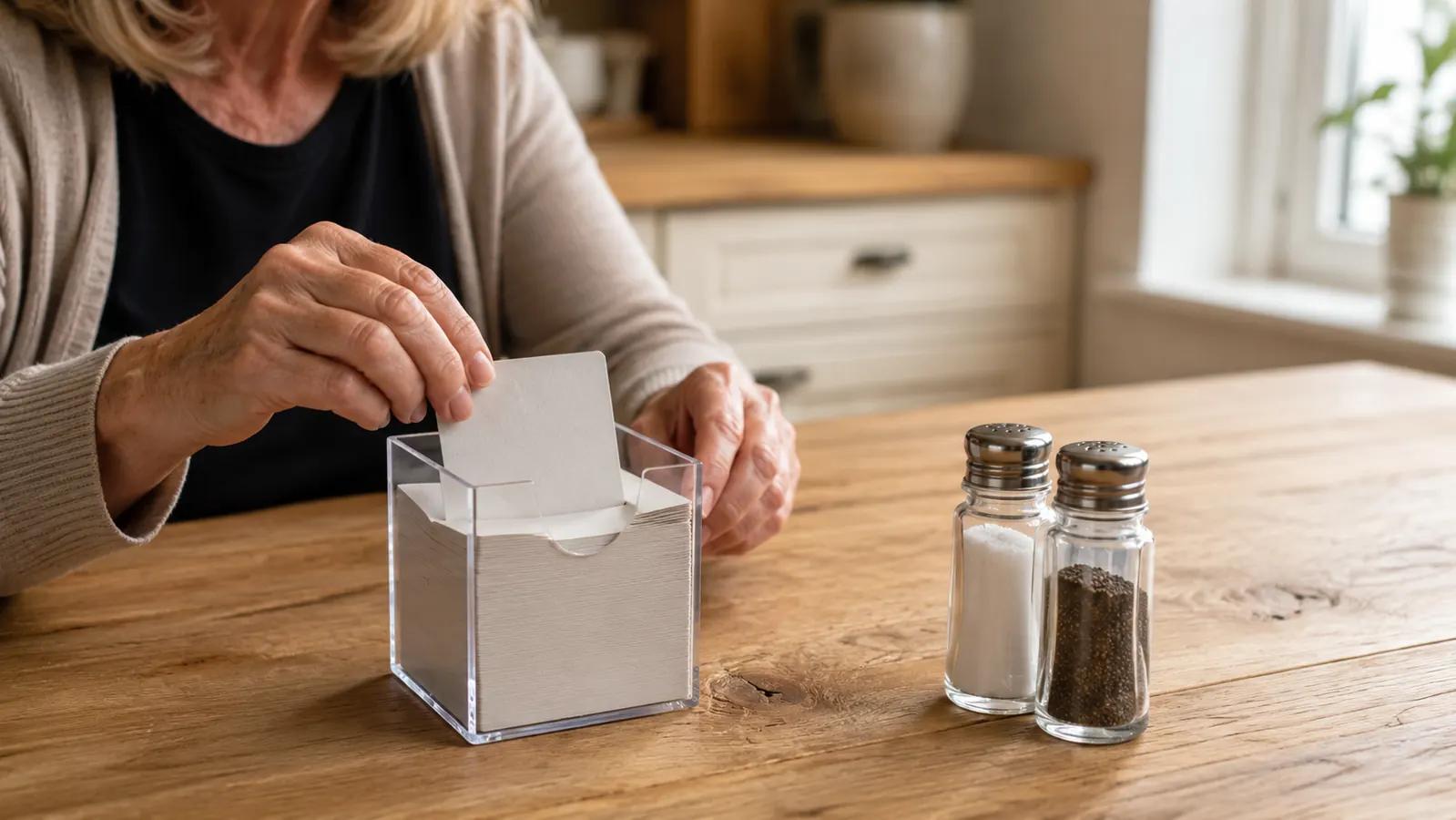
To be clear about the setup: this is not a game. There is no winner, no points, no timer, nothing to keep score with. It is a clear plastic cube, about the size of a small tissue box, filled with 135 cards. Each card has one printed question. You pull a card, read it out loud, answer it, and then the other person answers it. That is the whole thing. The box says it is made for two adult players, 21 and up, and the operation mode is manual, which is the most honest product description I have ever read. This product does nothing on its own. That is either a flaw or a feature, depending on whether you pick it up.
On a typical Thursday, after dinner, one of us reaches for the cube and pulls a card or two. Some nights we pull three or four because the conversation is rolling. Some nights we pull one and then get distracted talking about whatever it sparked, and the card sits face up on the table while we forget it is there. The cube lives on the kitchen table full time, which matters more than I expected. If we had to go find it in a drawer or a closet, we would not use it. I am sure of that.
Walt came around slowly. The first night he rolled his eyes hard enough that I almost put the cube away for good. Within the first month he was the one reaching for it. Now, if I clear the table and leave the cube in the kitchen, he goes and gets it. Neither of us decided to love it. We just kept showing up on Thursdays with the cube in reach, and after a few weeks the awkward part wore off on its own. That shift tells you the most important thing about this product: it is a tool, not a magic trick. You have to pick it up.
What Is Genuinely Good
The first thing that surprised me is how the questions are written. I expected either therapy-speak or the kind of cutesy prompts you see on Pinterest. What I got was mostly plain, specific questions that sound like a curious friend asked them. The listing gives a sample: 'Is it our similarities or our differences that attract us to each other?' That one is typical of the better cards. It is not a question you can answer in one word, and it is not a question you would ever think to ask on your own, because you assume you already know the answer.
The second thing is the range. Some questions are light, some are surprisingly deep, and a few are the kind you answer and then sit with for a while. Because you draw the cards at random, you do not get to choose your comfort level. Some nights you get an easy one and you are grateful. Some nights you get one that makes you look at Walt across the table and realize you have been married for 33 years and there are still rooms in him you have not visited. That sounds dramatic. It is not. It is just what happens when two tired people are handed a good question instead of a TV remote.
The third thing is the physical product. The cards are sturdy cardstock, the kind that does not bend or crease after nine months of weekly use. The cube is clear plastic and simple, and it looks fine sitting on the table. It weighs about 1.4 pounds, so it is not going anywhere. It is not beautiful, but it is not ugly either. It is just there, which is exactly what you want from something you are supposed to use every week.
What Nobody Tells You Before You Buy It
Here is the honest part, the part I wish someone had told me before I ordered. First, the questions are uneven. Out of 135 cards, I would guess that maybe a third are genuinely excellent, a third are fine, and a third are the kind you answer in one sentence and move on. A few are clearly written for couples who have not been together very long, questions about first dates and early impressions that Walt and I answered when we were dating in the early nineties and have covered thoroughly since. If you are a new couple, those will hit differently. For us, they are the cards we quietly put back and pull another.
Second, the cube does not do the work for you. This is the thing nobody tells you, and it is the thing that decides whether this product changes your Thursday nights or becomes a dust collector. If both people are not willing to answer honestly, the whole thing falls flat. If one person treats it as a chore, it will feel like a chore. The product is 135 questions. The willingness has to come from you. And to be clear, I have no arrangement with TableTopics. I bought this cube with my own money in February, same as anyone.
Third, you will hear repeats. Not exact repeats, but the same territory. After nine months and roughly three dozen Thursdays, we have pulled a good portion of the cube, and some questions circle the same themes: how you grew up, what you want out of the next ten years, what you admire about each other. That is not exactly a flaw, because the themes are the ones that matter, but if you use it as often as we do, you will eventually feel like you have seen most of it. We still pull cards. We are just not surprised as often as we were in month one.
Fourth, and this is the part I really mean when I say what nobody tells you: it is not a fix for anything. If a couple is in real trouble, a box of questions is not going to sort it out. We were never in trouble. We were in a rut, the specific rut where two people who love each other run out of things to say because every day sounds like the last one. This product is for ruts. It is not for crises. Anyone who tells you different is selling something, and it is not this cube.
How the Questions Work in Practice
One thing I have learned is that the best part of a good question is not the answer. It is what comes after. When Walt pulls a card about, say, what he would do with a year off, he answers in a sentence or two, and then I ask him a follow-up, and then he asks me one, and suddenly we are having the kind of conversation we used to have when we were dating and everything was still new. The card is just the door. You still have to walk through it.
The other thing worth knowing is that the questions work better over a slow dinner than as a structured activity. We tried once, early on, to treat it like a game, taking turns and keeping it snappy, and it felt like an interview. What works for us is pulling a card whenever the conversation lags, answering it, and letting it go wherever it goes. Sometimes the card is the whole conversation. Sometimes it is just the first sentence.
The cube holds 135 cards, which sounds like a lot and is, but it also means you will eventually see most of it if you use it weekly. I do not think that is a reason not to buy it. I think it is a reason to use it slowly. We pull one or two cards a week, not ten. Nine months in, we still have plenty we have not seen. That pacing has kept it from going stale, and I would recommend the same.
How It Fits Into a Real Thursday
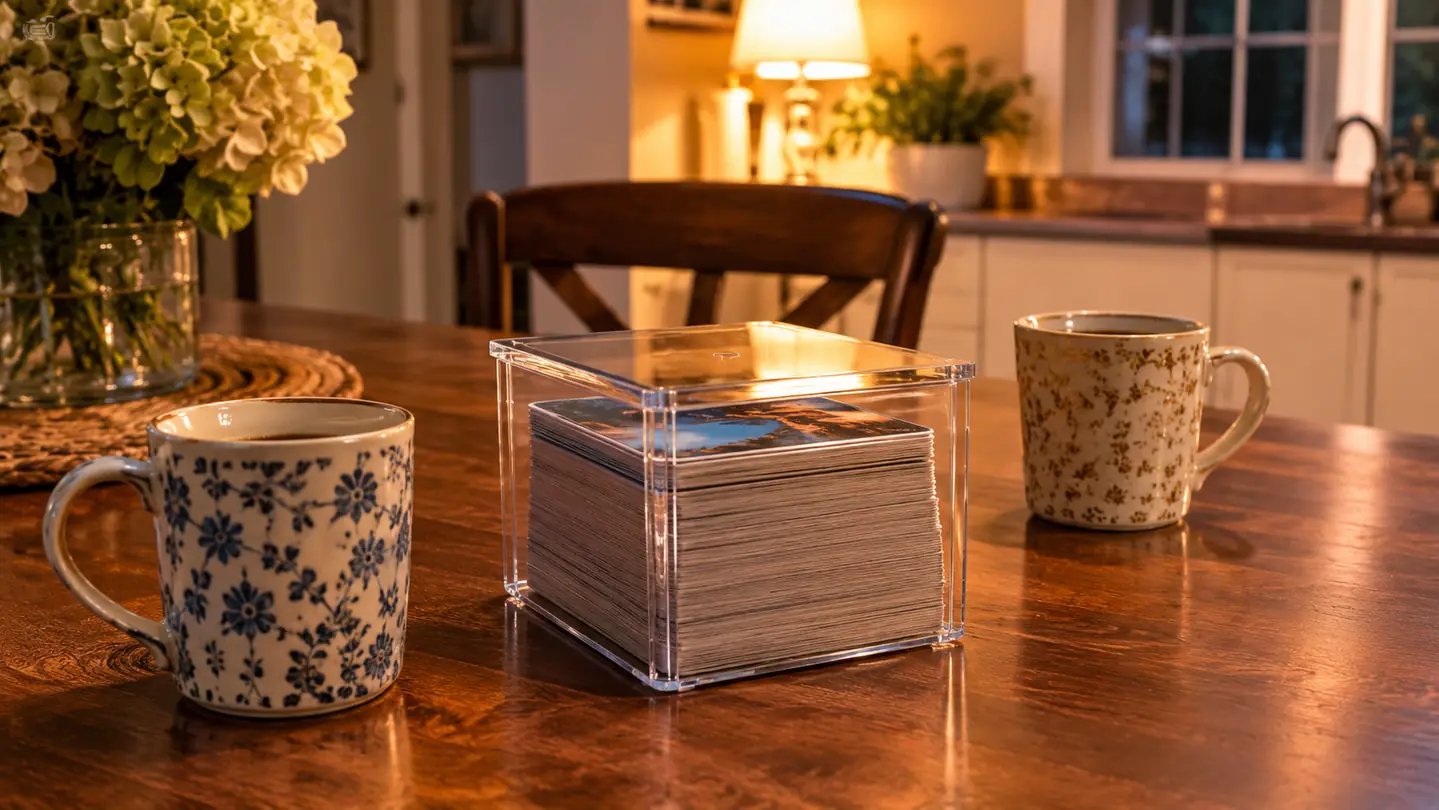
On the nights we make cheese fondue, which is about twice a month, the cube still comes out. The fondue is the excuse to sit longer, and the cards are the thing that keeps us talking once the cheese is gone. They work well together, and not because either one needs the other. Both of them just give two tired people a reason to stay at the table a little longer.
On the other Thursdays, it is just dinner and the cube. Some weeks we are both so worn out that we pull one card, answer it, and call it a date. That still counts. The cube does not care how long you talk. It does not grade you. Some of our best conversations have started with a single question and lasted twenty minutes. Some have lasted five. Both are fine.
What I Liked
- 135 sturdy cards in a clear cube that lives easily on the table
- Questions are mostly plain-spoken and specific, not therapy-speak
- Works as slow conversation over dinner, not a structured game
- Walt rolled his eyes the first night and came around within a month
- No scoring, no timer, no pressure, nothing to win or lose
- Light questions and deep questions mixed together
Where It Falls Short
- Some cards are clearly written for newer couples and fall flat for us
- The cube does nothing by itself; you have to actually use it
- Themes start to repeat after months of weekly use
- A handful of questions get a one-sentence answer and are forgotten
- Not a fix for real relationship problems, only for ruts
Walt rolled his eyes the first night. Within the first month, he was the one reaching for the cube.
Who This Is For
This is for couples who like each other but have gotten quiet. It is for people who eat dinner together and realize they have talked about the weather, the kids, the yard, and the news, and nothing else in a week. It is for newlyweds who want to skip the small talk and learn each other faster. It is for long-married couples who think they have covered everything and will be pleased to find out they have not. If you are willing to answer a question honestly, and your person is willing to do the same, this cube will give you more good Thursday nights than anything else we tried. TableTopics made it for exactly this, and it shows.
Who Should Skip It
Skip it if one of you is not interested. I cannot say this strongly enough. If you buy this hoping it will get a reluctant partner to open up, it will not. It will sit on the table and make you both feel guilty. Skip it if you are looking for a game, because it is not one, and it will disappoint you if you expect points or winners. And skip it if you are hoping it will fix something that needs more than a conversation. For that, find a counselor, not a cube. But if you are in a rut and both of you are willing to pick up a card, this is the most honest, useful little tool we found, and I would buy it again tomorrow.
If you are on the fence, here is my honest bottom line. This is not the most exciting thing we bought in February, and it is not the one that makes the room feel special. It is the one that actually changed how we eat dinner. The candles get lit, the fondue gets made, the projector comes out once in a while. The cube is the only thing that is on the table every single Thursday. That is the whole review, right there.
One cube, 135 questions, zero pressure
We have used it almost every Thursday for nine months. It is the only thing from our February experiment that still sits on the table.
Amazon Check Today's Price on Amazon →